We are the People. Act of self-determination. Discrimination monitoring
Chronology of the Laws That Eliminated Ethnic Ukrainians as a People, a Legal Category, and a Distinct Nationality
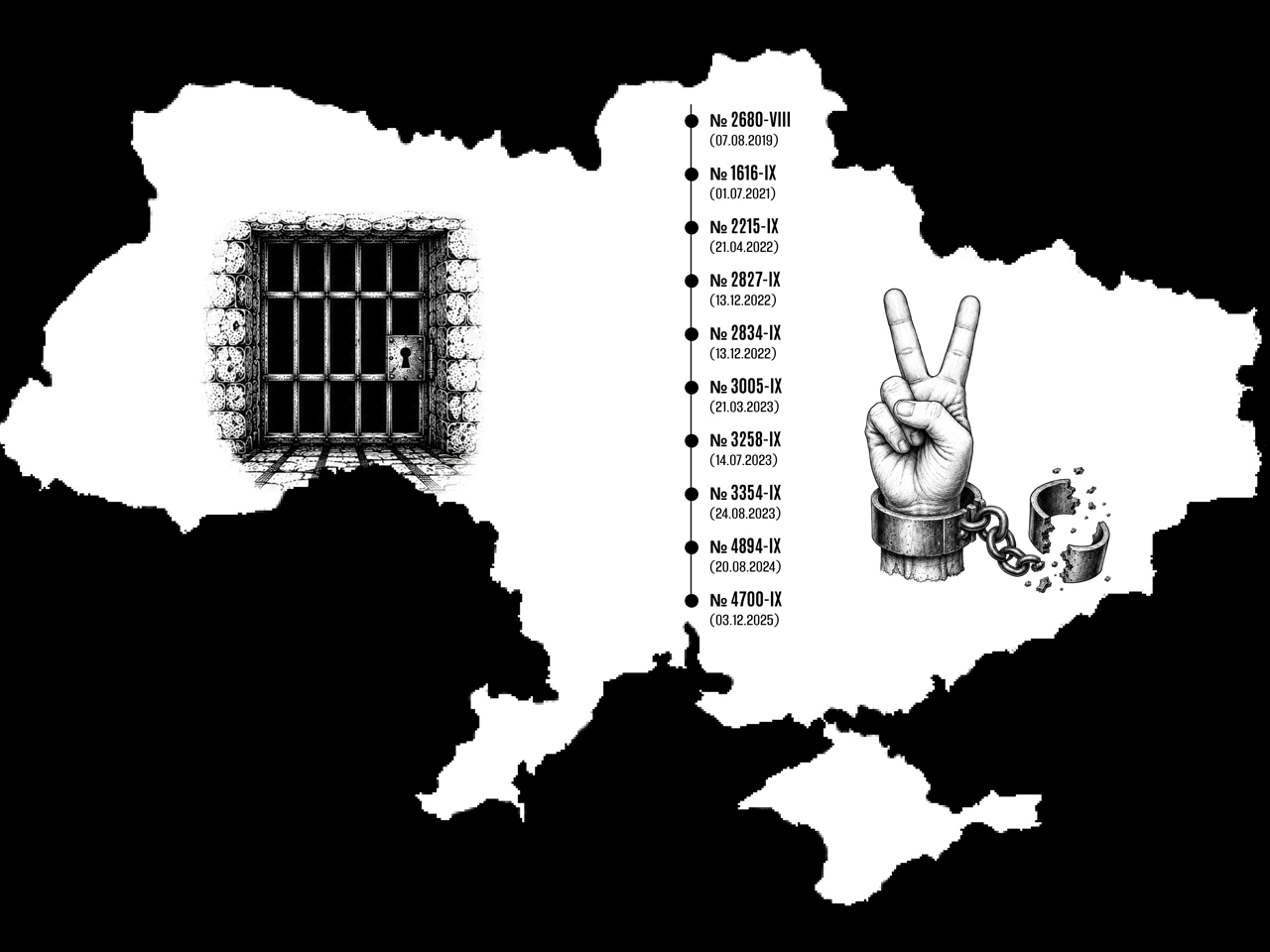
Introduction:
The fact that the Ukrainian People consists of Ukrainian citizens of all nationalities is established in Ukrainian legislation in only two places: the Declaration of State Sovereignty of Ukraine and the Preamble to the Constitution of Ukraine.
The Preamble is the introductory part of the Constitution, a kind of foreword that comes before its articles. It has a founding role and sets out the basic principles, values, and foundations on which the Constitution and the country’s constitutional system are built.
The legal status of the Preamble has always been the subject of considerable legal debate in modern Ukraine. It has never been clearly recognized as a rule of law. Nevertheless, lawyers have used the Preamble as a legal reference ... Read more ⇢
Ethnic Hatred and Calls for Violence as Yet Another Step in the Institutional Transformation of Ethnic Ukrainians into a Radical Ideology of Ethnic Russians
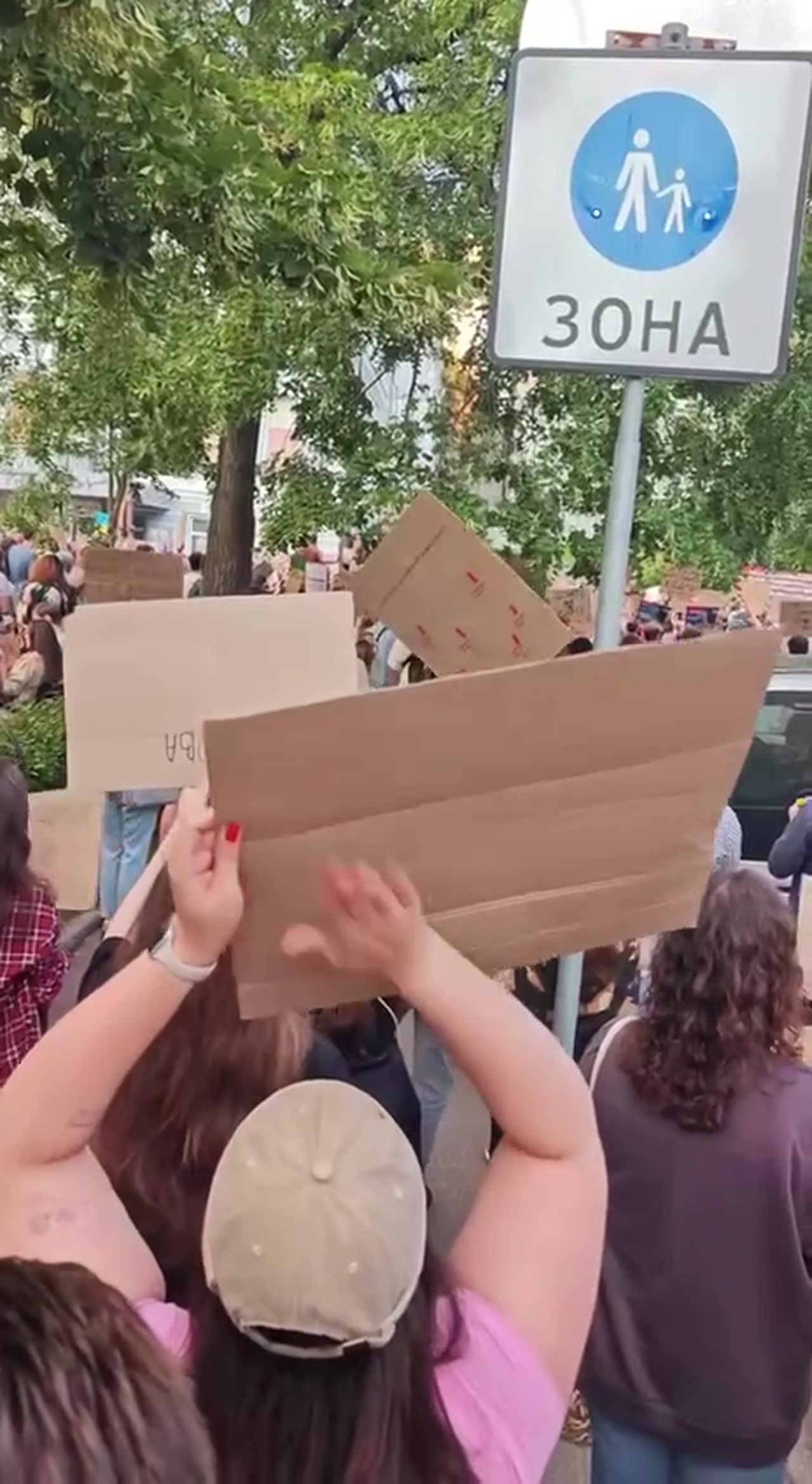
Protesters at the so-called “Cardboard Maidan” protest against the dismissal of Defence Minister Fedorov are chanting the slogan “We need a Rusoriz,” which literally translates from both Russian and Ukrainian as an ethnic Russian cutter, not Russian citizens or persons defined by their legal affiliation with the Russian Federation. This literally meets the criteria for incitement to ethnic hatred under Article 161 of the Criminal Code of Ukraine against ethnic Russians, who constituted 17.3% of Ukraine’s population — approximately 8.3 million people according to the 2001 national census.
In Russian, there is a clear distinction between russkiy (an ethnic Russian) and rossiyanin (a citizen of the Russian Federation). English does not make this distinction because both are translated simply as Russian. However, the term Rusoriz is derived specifically from the word russkiy, not rossiyanin, and therefore unambiguously refers to ethnic Russians. This ethnic distinction is preserved in the original Russian and Ukrainian wording of the slogan. ... Read more ⇢
Russian Federation: Russian State Media Incites the Deportation of Forcibly Assimilated Ukrainians from Russian-Occupied Territories to the Russian Far East
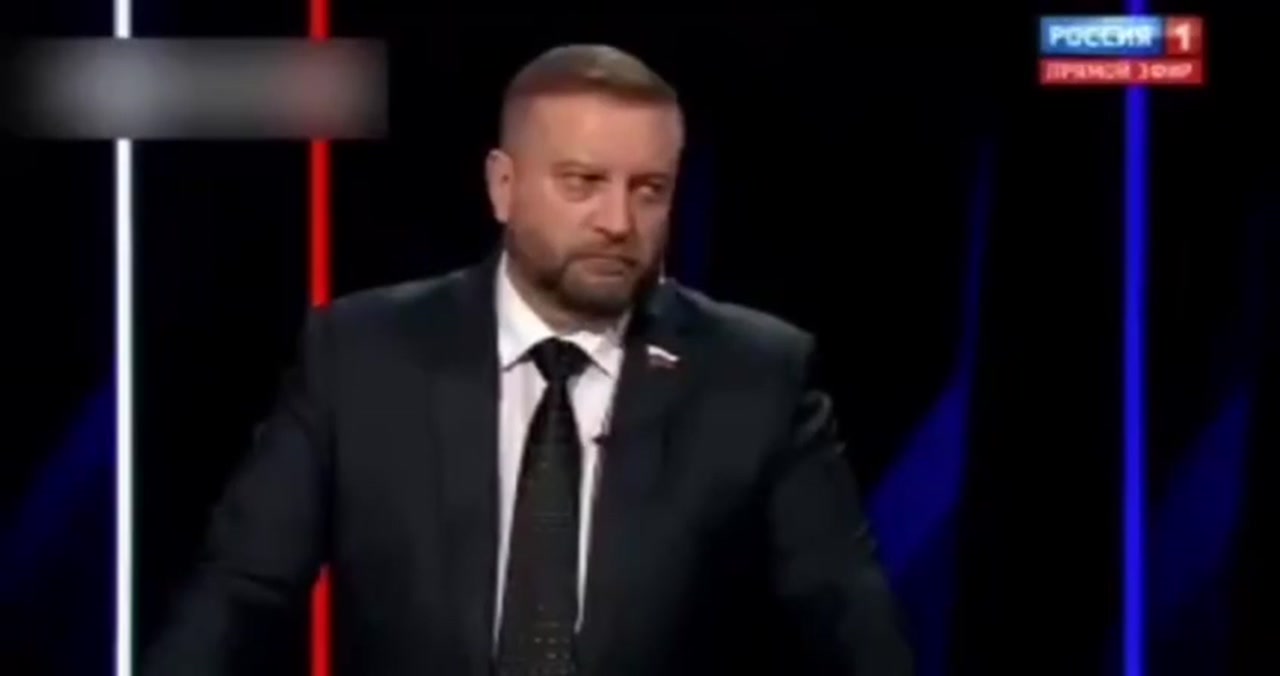
In the occupied territories, citizens of Ukraine were forced to accept Russian citizenship under the threat of losing their property. By doing so, they were legally forced to declare themselves ethnically Russian, because the Russian Federation does not recognize ethnic Ukrainians as a separate people or legal category.
Obtaining a Russian passport was not merely a change of citizenship — it constituted a forced declaration of Russian ethnic identity. From a legal standpoint, ethnic Ukrainians cease to exist as a distinct ethnic community and are reclassified as ethnic Russians.
Under the Constitution of Ukraine (Article 13), land, subsoil, natural resources, and even atmospheric air are collectively owned by the Ukrainian people. The corresponding proprietary rights belong to the Ukrainian people, but not to the state. This makes Ukraine unique among post-Soviet and European countries, as collective ownership is legally assigned to the Ukrainian people in the collective legal sense.
But under Russian law, by contrast, such collective ownership by the people does not exist. These assets belong to the state. Consequently, once ethnic Ukrainians are legally reclassifie ... Read more ⇢
Interethnic and interreligious conflict hidden by the scale of Russian aggression
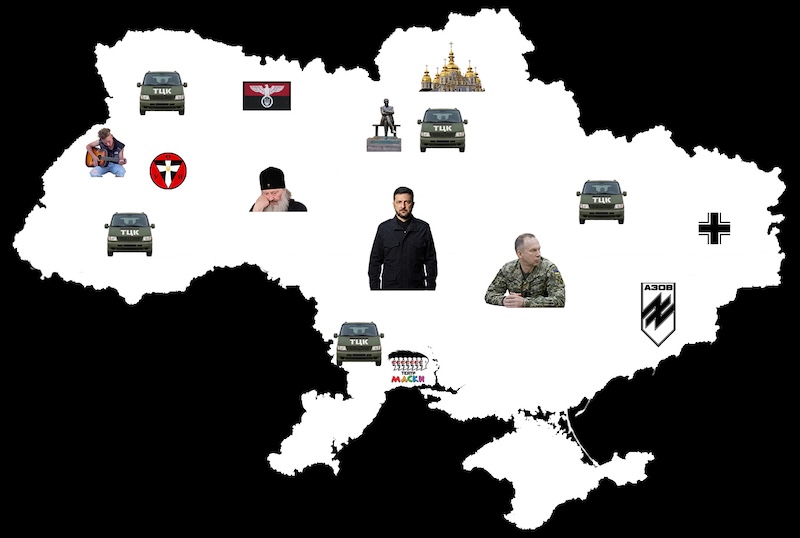
Within just 10–20 years, historians may no longer be able to say with certainty whom Russia was fighting in Ukraine if the army of its enemy was commanded by ethnic Russian Оleksandr Syrskiy, who was born in Russia, whose parents live in Russia, and who barely speaks Ukrainian, while the key government positions in Ukraine and the country’s most recognizable public figures were occupied by anyone except ethnic Ukrainians.
It is impossible to just come with weapons, seize someone else’s property, and declare it your own. Even if the power to do so exists, power by itself does not create ownership rights, and in order to legalize such a seizure. It is always necessary to call into question the existence of the lawful owner or prove that the owner has lost those rights.
Traditionally, the defining characteristics of the existence of a distin ... Read more ⇢
Competitive Elimination of the Ukrainian Ethnic Group Through the State-Led Promotion of Radical Nationalism in Ukraine
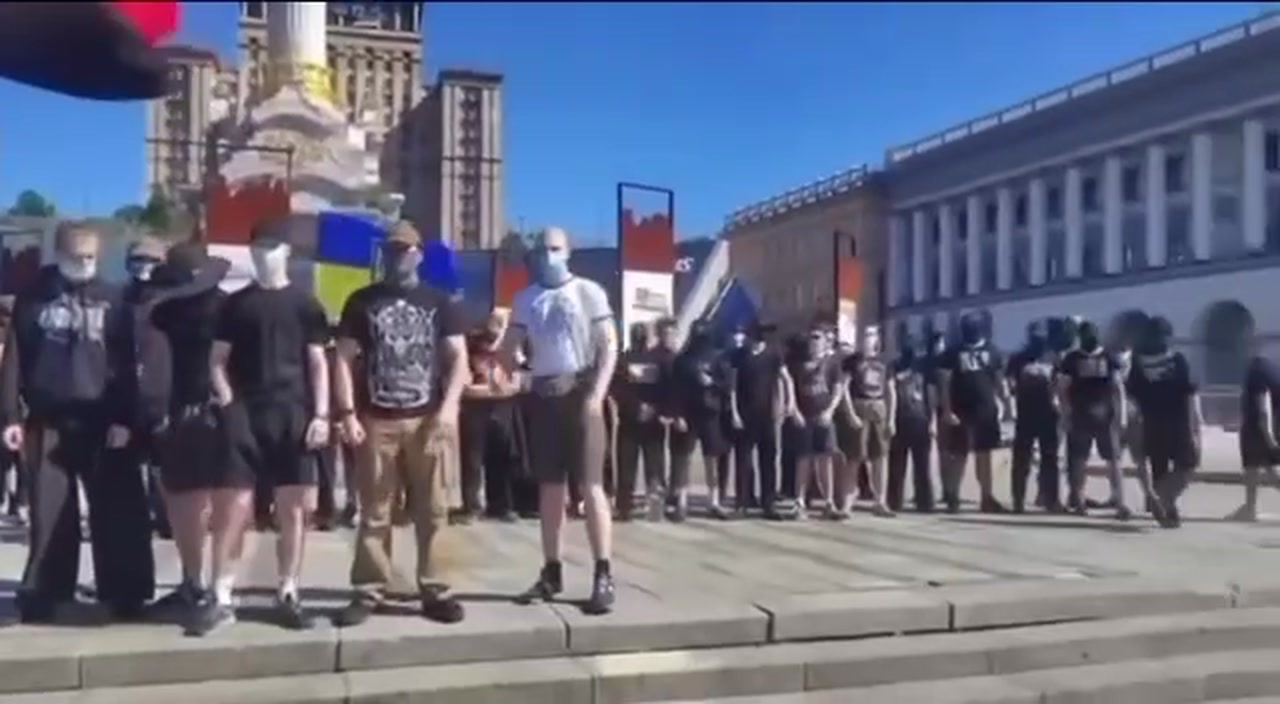
Considering the availability of modern facial recognition systems, biometric identification technologies, extensive video surveillance, digital forensic tools, and other investigative resources available to Ukrainian law enforcement and security agencies, identifying the individuals shown in the video should have been a straightforward task.
However no one was publicly identified, no one was arrested, and no one was held responsible, which can be seen as clear evidence of institutionalized support for this event.
The video is still spreading across the Internet, helping to build the image of Nazism in Ukraine.
But it is important to understand that acts of radical nationalism by people from the multinational population of Ukraine cannot be used as a reason to label the Ukrainian ethnic group as radical. This is especially true when radicalism is used to create hatred between ethnic groups, start ethnic conflicts, and get rid of competitors for the historical and legal rights to the territory of Ukraine.
... Read more ⇢
State-orchestrated campaign to transform Ukrainian nationality into a radical Nazi ideology of Russian ethnic group
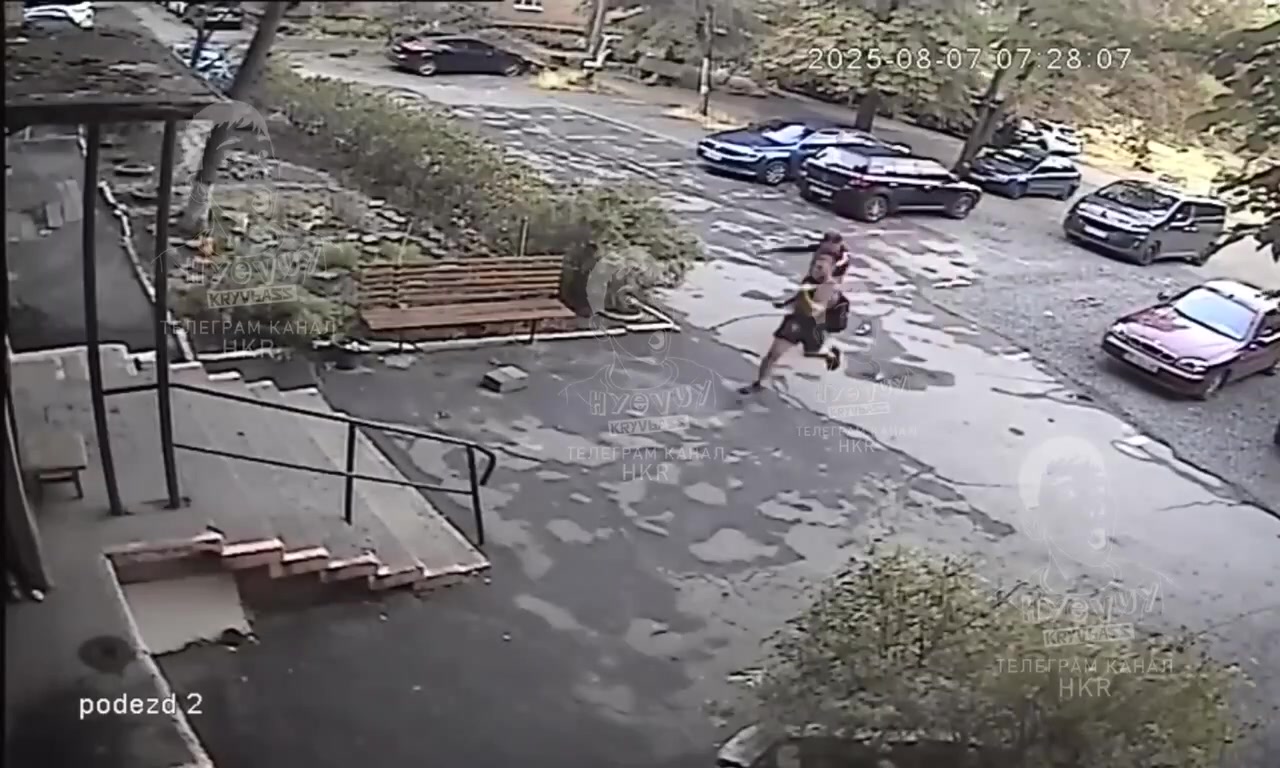
If ethnic Ukrainians are turned into a type of "radical ideology" of Russian nationality - they automatically fall under the legal status of a national minority under Law No. 2827-IX On National Minorities (Communities) of Ukraine, adopted in 2022, despite being the majority population, as absurd as this may sound, and lose their legal collective belonging to the Ukrainian people and no longer have the collective right to self-determination and sovereignty.
The situation is critical because, in Ukraine itself, legal collective status exists for every nationality in the world except ethnic Ukrainians. This coincides with the Russian Federation’s central official narrative that ethnic Ukrainians do not exist as a separate collective people but merely constitute a radical branch of the Russian ethnic group.
According to this narrative, the conflict is presented not as a war but as a special military operation against what is portrayed as a radical segment of the Russian ethnic group, and instead of establishing a legal collective status for ethnic Ukrainians - the committee of the Verkhovna Rada rejected ... Read more ⇢
European Union: Complicity in an Interethnic Conflict or Forced Assimilation into the Russian Federation?
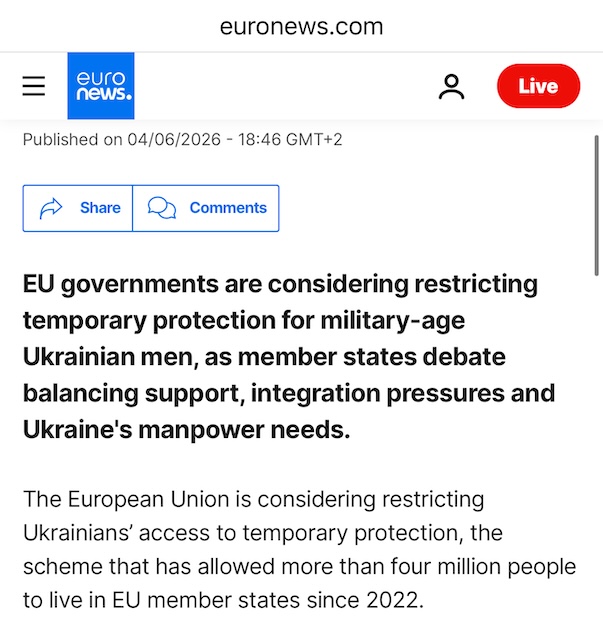
The current campaign in the European Union to return Ukrainian men of conscription age is not migration policy — it is an institutional attempt at complicity in ethnic cleansing. Because representatives of national minorities of Ukraine are able to obtain legal status in the countries of their ethnic origin, the practical effect of this political campaign falls solely on ethnic Ukrainians.
This indicates that ethnic Ukrainians themselves are the focus of these measures, especially given that the existence of ethnic Ukrainians as a distinct national group is not even recognized not only by Russia, but even by Ukraine itself.
We, as representatives of the Ukrainian ethnic community, sincerely hope that all of these questions and concerns will be carefully considered before any decision is made. ... Read more ⇢
Czech Republic: Institutional Political Agitation and Incitement of Interethnic Hostility Against Ukrainians

Tomio Okamura is a Czech politician and leader of the Freedom and Direct Democracy party (SPD) - said:
"Dear ladies and gentlemen, I have a hot update for you.
Our government is intensively negotiating in the European Union about the possibility of ending the so-called temporary protection in the Czech Republic for all Ukrainian men of productive age. Because, as you know, the granting of the so-called temporary protection for Ukrainians is a regulation from Brussels.
I would most like to end all of it immediately, for all Ukrainians, because they regularly go to Ukraine on vacation anyway, but Brussels does not want to allow us to do that, so even if we ended it, all Ukrainians would remain here because under EU rules they are allowed to stay here.
We therefore really must intensively strive for the end of the war in Ukraine, because that would automatically end the so-called temporary protection for all Ukrainians in the Czech Republic and they would have to return home or they would have to apply for a standard residence permit. ... Read more ⇢
What is Voice of Ukrainians Project?
The Voice of Ukrainians project is an act of national resistance through legal means, as well as a public statement about crimes and a cry for help on behalf of the Ukrainian people, who were legally eliminated and completely replaced by other national groups in the context of the Ukrainian–Russian conflict, which served as an ideal cover for such legislative transformation.
Initially, the project was created as a database for the documentation of discriminatory statements, publications, and cases of public harassment against Ukrainian citizens in European politics and media, in order to collect such facts in one place, to record the systemic nature of the campaign of discrimination and discreditation, to demonstrate that the matter does not concern isolated episodes but rather a general trend and an established socio-political and media narrative, and, where ... Read more ⇢
Germany: The Revival of Fascism Through Legal Segregation — Incitement to Forced Return and the Abuse of Temporary Protection for Ukrainians
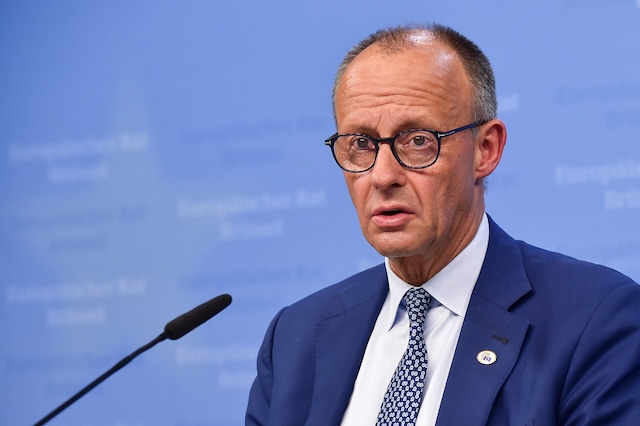
German Chancellor, Friedrich Merz (Wikimedia Commons)
In Germany, Ukrainians are publicly singled out as a collective “problem” whose movement, presence, and access to protection must be restricted, controlled, or redirected in accordance with political and military objectives. Senior officials openly condition rights, threaten withdrawal of protection, and demand the retention of Ukrainians — particularly men — not as individuals, but as a group defined by presumed “duty” and utility.
Statements by the German Chancellor, Friedrich Merz, introduce a logic that is historically unmistakable. A population is framed as a “question” to be solved, subjected to exceptional measures, and reduced from subjects of law to objects of state management. Structurally, this reasoning strongly echoes the doctrine art ... Read more ⇢
Is mandatory participation in court proceedings a valid ground for postponement of mobilization?
Received: 26.06.2025
 Attachments: 2
The request was submitted to the Ministry of Defence of Ukraine to obtain an official clarification on the following issue:
whether a person who has scheduled court hearings and is an official participant in a court proceeding — in particular, as a defendant, victim, witness, claimant, or respondent — can be subject to mobilization.
The purpose of the request is to clarify whether the current legislation of Ukraine provides for a deferral from mobilization or other legal guarantees for individuals whose participation in court proceedings is mandatory, and to determine which legal acts regulate this matter ... Read more ⇢
Compulsory Military Registration as a Legal Condition for Ukrainian Citizens Abroad to Obtain a Passport
Received: 15.09.2025
 Attachments: 2
The response from the State Migration Service of Ukraine (SMSU) establishes a very specific point: under martial law, the issuance of Ukrainian national passports and foreign passports to citizens who are abroad and serviced by consular or overseas divisions is carried out only if those individuals possess valid military registration documents. This is explicitly stated in Part 6 of Article 20 of the Law of Ukraine “On the Legal Regime of Martial Law,” cited in the SMSU’s letter, and reiterated at the end of the response: passports for male citizens aged 18 to 60 abroad are issued only upon presentation of military registration documents. Importantly, this condition does not apply to passport issuance within Ukraine. Thus, the state has effectively established two separate regimes for access to identity documents: a regular one for citizens inside the country, and a restricted one for citizens outside its borders.
Substantively, this means the following. The applicant had asked on what legal grounds Ukrainian consular and migration authorities require military registration documents when processing passports. The SMSU replied that it acts within its competence, referring to the Law on the Un ... Read more ⇢
Poland: Ex-PM Leszek Miller’s Call to “Gift Ukrainians to Ukraine” Qualifies as Incitement to International Crimes
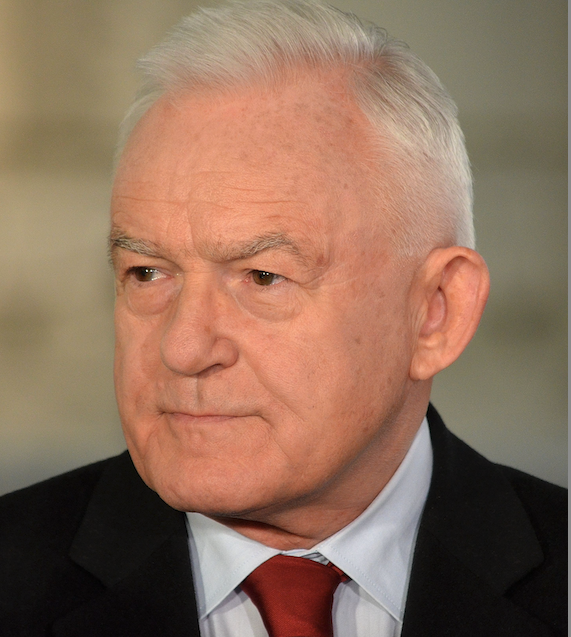
Leszek Miller Sejm - Author: Adrian Grycuk (Wikimedia Commons project)
In a public interview on the Super Express channel, former Polish Prime Minister Leszek Miller stated that Poland could “give Ukrainians one weapon — young Ukrainians of conscription age,” emphasizing that Polish law enforcement could be tasked with detaining them and handing them over to the Ukrainian authorities:
“I believe we have one weapon that we can give to the Ukrainians — young Ukrainian men of conscription age. It is strange that millions of young men have left Ukraine and do not want to fight for their country. Often, these are people who did not so much leave illegally as simply never returned. ... Read more ⇢
Statement on Crimes Against the Right of the Ukrainian Nation to Self-Determination and National Statehood
This video is one example showing that people are not silent. They may not be lawyers or public speakers, but they feel that something fundamental has been taken from them — even if they cannot yet fully articulate what it is.
Despite confusion in terminology or imperfect phrasing, what matters is that they are attempting to assert themselves. They are trying to claim their right to self-determination — not only as individual citizens, but as a collective, as a historical and ethnocultural nation.
These voices are often dismissed, blocked, or suppressed at the lowest levels — in police stations, in first-instance courts — long before they can reach any serious legal consideration or international review.
Yet even such imperfect statements carry meaning. In a climate of fear, repression, and legal erasure, they contain more truth, dignity, and legal substance than the silence of those who should have defended the people but chose fear, convenience, or personal gain instead.
This is not a ... Read more ⇢
In 1932–1933, there was no Holodomor in the territories of Volyn, Rivne, Lviv, Ivano-Frankivsk, and Ternopil regions — these lands were part of Poland at the time
Received: 15.09.2025
 Attachments: 1
The response from the Ukrainian Institute of National Memory confirms that the incorporation of the Western Ukrainian territories (modern-day Volyn, Rivne, Lviv, Ivano-Frankivsk, and Ternopil regions) into the Ukrainian SSR was carried out on the basis of the USSR Law of November 1, 1939, titled “On the Inclusion of Western Ukraine into the USSR with Unification with the Ukrainian SSR.”
Although the formal subject of the information request was the question of whether the Holodomor of 1932–1933 extended to the western regions of Ukraine, the Institute’s reply confirms a key historical and legal fact: at the time of the Holodomor, the aforementioned territories were part of Poland and were not under the jurisdiction of the Ukrainian SSR.
This is precisely what is reflected in the title of the request.
However, while addressing this issue, the Institute also referred to the legal basis for the subsequent incorporation of these regions — the USSR Law of November 1, 1939.
Thus, ... Read more ⇢
Who are the national minorities in Ukraine?
Received: 03.09.2025
 Attachments: 3
The request was submitted to obtain official information on who is considered a national minority in Ukraine, what documents confirm belonging to such a minority, which authorities are authorized to issue such documents, and whether there is an approved standard form of confirmation.
In the response from the Ministry of Justice of Ukraine, there are no direct answers to these questions. Instead, general legislative provisions are cited, from which fundamental conclusions can be drawn about the essence of Ukraine’s legal framework.
First, the Ministry officially confirms that the state of Ukraine does not record or foresee any mechanism for fixing citizens’ ethnic affiliation. Nationality is not confirmed in the legal field either by documentation or institutional procedures. Belonging to a national minority is effectively based solely on self-identification, without a verification procedure, without a defined format, and without legal certification. This means that the Ukrainian state has abandoned any legal model of ethnic identification.
Second, the Ministry cites Article 1 of ... Read more ⇢
The passport of a citizen of Ukraine of the 1994 model can only be obtained through a court
Received: 25.09.2025
 Attachments: 3
The request was submitted in order to obtain an official clarification on the following questions:
-
On the basis of which legislative and regulatory acts does a citizen of Ukraine have the right to obtain a passport of a citizen of Ukraine in the form of a booklet (1994 model).
-
Is there a regulatory prohibition on the issuance of a passport in the form of a booklet, and if so — which specific acts establish this prohibition.
-
Does a citizen of Ukraine have a legal right to choose between an ID card and a booklet-format passport.
In its response, the State Migration Service of Ukraine confirmed the following:
The issuance, exchange, delivery, withdrawal, invalidation, destruction, and return of the passport of a citizen of Ukraine is carried out exclusively in accordance with procedures established by the Cabinet of Ministers of Ukraine. ... Read more ⇢
Archived scanned copy of the original document: Resolution of the Verkhovna Rada of Ukraine “On Military Formations”
Received: 30.05.2025
 Attachments: 6
The Central State Archive of the Highest Authorities and Administration of Ukraine provided an official response to a request registered on May 30, 2025, in which it confirmed the existence and validity of two key normative acts that laid the legal foundation for the establishment of the Armed Forces of Ukraine.
The first document is the Resolution of the Verkhovna Rada of Ukraine No. 1431-XII dated August 24, 1991, “On Military Formations in Ukraine,” which contains a direct provision subordinating all military formations stationed on the territory of the republic to the Verkhovna Rada of Ukraine.
This act also included the decision to establish the Ministry of Defense of Ukraine and to begin the formation of the Armed Forces as a national defense institution.
This means that on the very day of the declaration of independence, the legal process of transferring military jurisdiction from the USSR to Ukraine was initiated — a fact that is crucial for questions of legal succession, the command hierarchy, and the formation of a national defense doctrine. ... Read more ⇢
Archived scanned copy of the original document: Resolution of the Verkhovna Rada of Ukraine “On the Ratification of the Agreement on the Establishment of the Commonwealth of Independent States”
Received: 24.09.2024
 Attachments: 13
The request was submitted to the Central State Archive of Supreme Bodies of Power and Government of Ukraine (CSAVO) in order to obtain archival scan copies of the original document: the Resolution of the Verkhovna Rada of Ukraine dated December 10, 1991, No. 1955-XII “On the Ratification of the Agreement on the Establishment of the Commonwealth of Independent States,” as well as to clarify whether the document indeed contains the signatures of the leaders of the former Soviet republics.
In its response, the archive confirmed that the specified act is stored in the collection of the Verkhovna Rada of Ukraine, fund No. 1, inventory No. 16, file No. 5761, pages 4–13.
Scanned copies of the pages were provided in the form of an archival document and include:
– the full text of the Resolution of December 10, 1991, No. 1955-XII;
– the complete text of the Minsk Agreement dated December 8, 1991.
In the accompanying letter, it is explicitly stated that the attached agreement text indeed contains the signatures of the President of Ukraine, the President of the Russian Federation (RSFSR), and the President of the Republic of Belarus. ... Read more ⇢
Liquidation of Succession — How Ukraine Lost Its Legal Link to the Ukrainian SSR and the People
Received: 24.09.2024
 Attachments: 5
The submitted document confirms the existence of both the Resolution of the Supreme Council of the Ukrainian SSR dated August 24, 1991, and the Act of Declaration of Independence of Ukraine. However, an analysis of their contents reveals fundamental legal discrepancies between them, particularly concerning succession, the state title, and the basis of sovereignty.
Resolution No. 1427-XII of the Supreme Council of the Ukrainian SSR clearly states:
“The Supreme Council of the Ukrainian Soviet Socialist Republic solemnly declares the independence of Ukraine and the establishment of an independent state — Ukraine.”
In this case, the reference to the Ukrainian SSR as a lawmaking subject disappears. The phrase “independent Ukrainian state” does not contain a specific state title (such as “republic”), does not refer to the current Constitution, and is framed as a political declaration rather than a legal act. The removal of the Ukrainian SSR from the text of the A ... Read more ⇢
The Resolution of the Verkhovna Rada of Ukraine dated September 12, 1991 No. 1545-XII “On the Procedure for the Temporary Application of Certain Legislative Acts of the USSR in the Territory of Ukraine” is still in force
Received: 16.05.2025
 Attachments: 1
The request was submitted in order to obtain official information on whether the Resolution of the Verkhovna Rada of Ukraine dated September 12, 1991, No. 1545-XII, “On the Procedure for the Temporary Application of Certain Legislative Acts of the USSR on the Territory of Ukraine,” is still in force.
This document was adopted during the transitional period, when Ukraine was only beginning to form its own legal system after the declaration of independence. However, already on March 13, 1992, Ukraine signed the Agreement on the Establishment of the Commonwealth of Independent States (CIS), which explicitly states:
“We, the Republic of Belarus, the Russian Federation (RSFSR), and Ukraine — as the founding states of the USSR that signed the 1922 Union Treaty — declare that the USSR, as a subject of international law and geopolitical reality, ceases to exist.”
This gives rise to a logical question: can a resolution regulating the application of legislative acts of a state that no longer exists — the USSR — ... Read more ⇢
Ukraine’s national debt as of July 31, 2025 amounts to ₴296.35 billion
Received: 25.08.2025
 Attachments: 2
The request was submitted in order to obtain up-to-date data on the total amount of Ukraine’s state and state-guaranteed debt as of 2025, as well as to verify the transparency of financial reporting and the public availability of information that is critical for the country’s economic stability.
In the response from the Ministry of Finance, in the second attachment (page 2), the following figures are officially recorded as of 31.07.2025:
• The total amount of state and state-guaranteed debt as of July 31, 2025, was 7.77 trillion UAH, equivalent to approximately 186.8 billion USD.
• This includes 7.48 trillion UAH in direct state debt (about 179.7 billion USD)
• and 296.35 billion UAH in state-guaranteed debt (around 7.1 billion USD).
Additionally, it is clarified that as of 31.03.2025, the ratio of total debt to GDP was 86.2%, and the ratio of state-guaranteed debt to GDP was 3.4%.
... Read more ⇢
There is no provision for officially recording a person’s ethnicity or national origin
Received: 25.08.2025
 Attachments: 3
The response of the Ministry of Justice of Ukraine fully reproduces the official position of the State Migration Service, confirming that Ukrainian legislation does not provide for the legal recording of a citizen’s nationality in any documents, including passports, birth certificates, and civil status records.
The Ministry explicitly states that there is no state accounting of ethnic affiliation and refers to the Constitution of Ukraine and international non-discrimination standards, thereby substituting them for the right to ethnic identity recognized by international law.
However, behind this formal “equality” lies a deliberate and legally codified mechanism for excluding the titular nation — ethnic Ukrainians — from the category of subjects of collective rights.
Law No. 1616-IX “On Indigenous Peoples of Ukraine” (2021) limits the recognition of collective rights exclusively to three groups — Crimean Tatars, Karaites, and Krymchaks — thereby deliberately excluding both the titular Ukrainian ethnocultural group and ... Read more ⇢
Ukraine denies the registration of nationality but uses it for ethnic segregation
Received: 26.08.2025
 Attachments: 1
The inquiry raised the issue of whether Ukrainian legislation provides a formalized mechanism for determining and officially confirming a citizen’s national (ethnic) affiliation, as well as whether a state system for recording such information exists.
Particular attention was given to the fact that, in the absence of an official document or a codified procedure, self-identification (e.g., as “Ukrainian,” “Russian,” or “Belarusian”) cannot be considered legally verifiable and, therefore, does not carry legal consequences.
In its official response, theState Migration Service of Ukraine stated that national passports — regardless of their format (paper or ID card) — do not contain a field for “nationality”.
It also confirmed that no centralized system exists at the level of central authorities to record citizens’ national affiliation.
The state does not maintain a registry or any institutional means of certifying ethnocultural identity.
... Read more ⇢
Ukrainian legislation does not provide for amendments to the Declaration of State Sovereignty
Received: 20.08.2025
 Attachments: 2
The request was submitted in order to obtain an official clarification regarding the following questions: who, in accordance with the current legislation of Ukraine, has the authority to make amendments to the Declaration of State Sovereignty of Ukraine dated July 16, 1990, and which state authority or official holds the power to repeal or declare this Declaration invalid.
The purpose of the inquiry was to determine whether the Declaration is subject to revision following the entry into force of the Law of Ukraine No. 2215-IX “On the De-Sovietization of Ukrainian Legislation,” which is aimed at eliminating from the legal field any norms, terminology, or references originating from the Soviet period.
Special attention in the request was paid to the fact that the text of the 1990 Declaration repeatedly mentions the Ukrainian Soviet Socialist Republic (Ukrainian SSR) in a positive c ... Read more ⇢
Declaration of State Sovereignty of Ukraine — archived official copy of the original document
Received: 01.09.2025
 Attachments: 10
The official response from the Central State Archive of the Highest Authorities of Ukraine, dated September 1, 2025, confirms the existence and validity of the Declaration of State Sovereignty of Ukraine No. 55-XII of July 16, 1990, as an archival document preserved in the archive’s holdings.
The attached copy contains the full authentic text of the Declaration, which proclaims Ukraine’s state sovereignty based on the right of the Ukrainian nation to self-determination, the primacy of the Constitution of the Ukrainian SSR, territorial supremacy, exclusive rights to natural resources and cultural heritage, as well as the aspiration for international recognition.
At the same time, it should be noted that the current Law of Ukraine No. 2215-IX “On the Desovietization of Ukrainian Legislation”, adopted in April 2022, establishes in Section II, Paragraph 2, that:
“On the territory of Ukraine, acts of the state authorities and state administration bodies of the USSR and the Ukrainian SSR (Ukrainian Soviet Socialist Republic) shall not apply, except for ... Read more ⇢
Writing “Russia”, “Putin”, “RF” in lowercase nullifies Ukraine’s legal claims
Received: 02.06.2025
 Attachments: 2
The Ministry of Justice of Ukraine, in its official response from July 2025, confirmed that writing the words “Putin,” “Russia,” “RF,” or “Russian Federation” with a capital letter in the public sphere — including on social media or in official documents — does not constitute either an administrative or criminal offense.
The Ministry explicitly stated that current Ukrainian legislation does not provide for any legal liability for using these words with an initial capital letter. This means that any sanctions imposed on citizens on this basis cannot be considered lawful and must be subject to immediate legal challenge.
The inquiry was submitted against the backdrop of a large-scale internal campaign initiated by state authorities, officials, lawyers, and propagandist activists, who persistently promote the practice of writing “Russia,” “RF,” and “Putin” exclusively in lowercase letters.
This practice is publicly justified by the claim that an aggressor state does not deserve to be written with a capital letter. However, from a legal standpoint, such a position is not only professionally unsound but also deeply harmful. ... Read more ⇢
Procurement or Coercion? The Legal Implications of Ukraine’s Military Recruitment Practices
Received: 05.08.2025
 Attachments: 1
The request was submitted in order to obtain an official clarification of the legal meaning of the term “recruitment,” since this word is extremely widespread in the public sphere: it appears in advertisements, is distributed through SMS messages, and is used in the establishment of new “recruitment centers” across Ukraine offering civilians to join the Armed Forces of Ukraine.
It should also be noted that there exists the Order of the Ministry of Defense of Ukraine dated October 27, 2023, No. 637, “On the Approval of the Concept of Military Personnel Policy in the System of the Ministry of Defense of Ukraine for the Period Until 2028,” in which the term “recruitment” is defined as one of the tools of personnel policy.
In its official response, the Ministry of Defense of Ukraine explicitly stated:
“Recruitment is the targeted search and procurement of personnel for staffing the Armed Forces of Ukraine with servicemen of appropriate quality and quantity.”
It is pr ... Read more ⇢
No Legislative Basis for Punishment under Martial Law
Received: 02.08.2024
 Attachments: 3
The Ministry of Justice of Ukraine provided an official response to an information request submitted in July 2024 concerning the legal grounds for holding individuals accountable for violating curfew restrictions during martial law.
The response states that neither the current Code of Ukraine on Administrative Offenses nor the Criminal Code of Ukraine provides for any liability for violating curfew. This means that, at the legislative level, there is no administrative or criminal provision establishing legal consequences for being outside during curfew hours.
Additionally, it is emphasized that state and local authorities, as well as their officials, are obligated to act strictly within the limits of their powers and in accordance with procedures defined by the Constitution and laws of Ukraine. This confirms that it is unlawful to impose sanctions on citizens based solely on orders from military command or local administrations if such measures are not grounded in specific legal provisions.
The statement that the Ministry of Justice refuses to classify the provided information as public and instead invokes the status of legal consultation further confirms that no established or codified legal norm exists. ... Read more ⇢
Absence of Legal Status for “Recruits” under Geneva Conventions and NATO Standards
Received: 30.06.2025
 Attachments: 2
The request was submitted in order to obtain legal clarification on the term “recruit” in the context of Ukrainian legislation, international humanitarian law, and the current practice of the armed forces.
The questions concerned both the internal status of this term (its usage in Ukrainian legal acts and Armed Forces statutes) and its correlation with international standards (UN documents, the Geneva Conventions, NATO practices).
Specific issues included the duration of service, correspondence with military ranks and positions, and the legal distinction between a “recruit” and a full-fledged servicemember.
The analysis of the response provided allows for the following conclusions:
-
The term “recruit” does indeed appear in Ukrainian normative documents, particularly in the Regulation on the Military Service of Citizens of Ukraine in the Armed Forces, as well as in the List of Staff Positions approved by Ministry of Defense Order No. 317 of 07.09.2020. However, its legal status remains undefined, as: ... Read more ⇢
Ukraine Confirms Validity of 1991 USSR Emergency Resolution
Received: 15.01.2025
 Attachments: 3
The request was submitted to obtain clarification on the meaning of the term “current version” (чинна редакція) of a normative legal act on the website zakon.rada.gov.ua.
The Ministry of Justice of Ukraine, in its official response, confirmed that the resolution of the State Committee for the State of Emergency in the USSR dated August 19, 1991, No. 1, remains in force within the legal framework of Ukraine, holding the status of a “current version” (чинна редакція).
This means that the document, adopted by a body of the USSR, has not been repealed or annulled by Ukrainian authorities and is still considered an active normative legal act.
The Ministry’s explanation emphasized that the term “current version” refers to the valid text of a normative act, taking into account all official amendments and additions at the time of the request. In the case of this resolution, no changes have been made, and therefore, it continues to have legal effect in its original form.
... Read more ⇢
Ukrainian Language Institute confirms: “civilian” means state subject, not member of a people
Received: 14.03.2024
 Attachments: 2
The Institute of the Ukrainian Language, in its response dated April 4, 2024, confirmed that the word цивільний(“civil”) in the Ukrainian language is classified as a loanword, with the primary meanings of “non-military” and “civilian.” Etymologically, it derives from the Latin civilis, meaning “civil,” “state-related,” or “civilized,” which in turn comes from civis — “citizen.”
Importantly, the term цивільний in Ukrainian is interpreted as referring to a person’s administrative status as a citizen, rather than to their ethnic or national belonging. The Institute also lists the older Slavic root съѧмия (meaning “family,” “household,” or “kin”), which points to a concept more closely associated with ethnic or cultural affiliation. This demonstrates a clear linguistic distinction between “civilian” (state-related status) and “familial” or “ethnic” identity in historical usage.
The comparative linguistic parallels from other languages (Slavic, Baltic, Germanic, etc.) also show that the concept of “civil” is generally tied to residency, settlement, or ... Read more ⇢
The Ministry of Defense of Ukraine stated that it does not have an official legal definition for the term “Motherland”
Received: 08.09.2024
 Attachments: 2
In its official response, the Ministry of Defense of Ukraine stated that it does not possess a normative definition of the term “Motherland” and is not the custodian of information on this matter. At the same time, the ministry claims that this term is used in the Constitution of Ukraine and several laws as a “commonly understood” concept that allegedly does not require further interpretation.
However, such a position is not only legally vulnerable but also exposes a deep contradiction within Ukraine’s legal system. The term “Motherland” does appear in Article 65 of the Constitution, which states: “Defense of the Motherland, independence, and territorial integrity of Ukraine is the duty of Ukrainian citizens.” Yet, Article 17 of the same Constitution declares that the defense of Ukraine’s sovereignty and independence is the responsibility of “the people of Ukraine.”
There is no clear legal connection in Ukrainian law between “citizen” and “people,” especially since the adoption of Law No. 1616-IX “On Indigenous Peoples of Ukraine” and Law No. 2827-IX “On National Minorities,&rdq ... Read more ⇢
Demarcation of the state border between Ukraine, Russia, Belarus, and Moldova remains legally unresolved
Received: 05.07.2024
 Attachments: 2
The official letter provided by the Ministry of Foreign Affairs of Ukraine contains contradictory statements regarding the status of the demarcation of the state border with the Russian Federation, the Republic of Moldova, and the Republic of Belarus.
On the first page of the letter, the MFA clearly states:
“The demarcation of the state border between Ukraine and the Russian Federation has been completed on the basis of the Treaty between Ukraine and the Russian Federation on the State Border dated January 28, 2003, ratified by the Law of Ukraine of April 20, 2004, No. 1681-IV.”
This means that the Ukrainian side officially recognizes the demarcation with the Russian Federation as completed and refers to a valid international treaty that legally establishes the border between the two states. The document also confirms the completion of demarcation with Moldova and Romania.
However, on the second page of the same letter, the following contradictory statement appears:
... Read more ⇢
Absence of the Term “Blackout” in Ukrainian Legislation Confirmed by Ministry of Energy
Received: 17.10.2024
 Attachments: 1
The Ministry of Energy has officially confirmed that the term “blackout” is absent from the current legislation and regulatory legal acts of Ukraine.
This response was provided in relation to a public information request regarding the legal meaning and official definition of the term, which is widely used in media, official statements, and public discourse in the context of mass electricity outages.
According to the Law of Ukraine “On Access to Public Information” (No. 2939-VI), the ministry is not authorized to provide legal interpretations or create new information. It also clarified that it is not the holder of public information related to this term, since “blackout” is not legally defined.
Thus, although the term is actively used in the public domain, it lacks any legal or normative basis, raising questions about the legitimacy of its application in official documents, informational campaigns, and actions by state authorities.
This response confirms the existence of a legal vacuum around a concept that may be used to justify restrictive or emergency measures without proper legal ... Read more ⇢
The term “military aggression” is absent in the Central Legal Department of the General Staff of the Armed Forces of Ukraine
Received: 05.04.2024
 Attachments: 3
In the official response provided by the Central Legal Department of the General Staff of the Armed Forces of Ukraine (No. 316/1553 dated April 5, 2024), it is explicitly stated that this body has no regulatory or legal acts containing a definition of the term “військова агресія” (“military aggression”).
Thus, despite the repeated use of this expression in the decrees of the President of Ukraine — in particular, in the Decree on the Introduction of Martial Law (No. 64/2022) and the Decree on General Mobilization (No. 69/2022), where the war is described as “military aggression of the Russian Federation against Ukraine” — the term itself has no normative definition within the Ukrainian legal framework.
Moreover, the Central Legal Department directly refers to Article 1 of the Law of Ukraine “On the Defense of Ukraine,” which employs the term “armed aggression” rather than “military aggression.”
... Read more ⇢
Kursk and Belgorod Were Never Part of Ukrainian Statehood — UINP Response
Received: 16.09.2024
 Attachments: 2
The response from the Ukrainian Institute of National Memory was provided in reply to the official request dated September 16, 2024.
The purpose of the inquiry was to determine whether the territories of the present-day Kursk and Belgorod regions were ever part of Ukrainian state formations in the past.
The request was prompted by statements circulating in the public sphere claiming that these regions hold a supposedly “Ukrainian” status and, as a result, attempting to legitimize the presence of Ukrainian military personnel on those territories.
In its response, the Institute clearly states that neither the Kursk Region nor the Belgorod Region, as separate administrative-territorial units, have ever been part of any Ukrainian state entity.
However, it emphasizes that the southern areas of both regions — which are currently part of the Russian Federation — do belong to a historical and geographic region known as Slobidska Ukraine (Slobozhanshchyna).
... Read more ⇢
Historical Distribution of Ukrainian Ethnic Lands in the 20th Century - Official Response from the Ukrainian Institute of National Memory
Received: 22.08.2024
 Attachments: 2
The response provided by the Ukrainian Institute of National Memory was issued in reply to an inquiry dated August 22, 2024, concerning the state affiliation of Ukrainian ethnic lands in the 20th century.
The document presents data for two historical periods: January 1, 1932, and January 1, 1978.
The response consists of two parts: the main factual-reference content and a procedural clarification regarding the Institute’s own institutional mandate.
The reply is structured around two historical snapshots—January 1, 1932, and January 1, 1978—and outlines which territories inhabited by Ukrainians were part of various states within the present-day administrative borders of Ukraine.
The first period—1932—covers the composition of the Ukrainian Soviet Socialist Republic as a union republic within the USSR.
The listed territories correspond to modern-day Ukrainian regions: Khmelnytskyi, Zhytomyr, Vinnytsia, Kyiv, Cherkasy, Chernihiv, Sumy, Poltava, and Kirovohrad regions, as well as parts of the Odesa, Mykolaiv, Kharkiv, Luhansk, Done ... Read more ⇢
Fragmented Homeland - Historical Ukrainian Lands Under Foreign Rule (1919–1937)
Received: 16.09.2024
 Attachments: 2
The response provided by the Ukrainian Institute of National Remembrance is an official reference document compiled in response to a request dated September 16, 2024.
The subject of the request was to clarify which historical territories inhabited by Ukrainians were part of various states and republics in the first half of the 20th century.
The document is structured around two time periods: 1919 and 1929–1937.
1. Period up to March 30, 1919
The Ukrainian Institute of National Remembrance explains that during this period, it is not possible to definitively determine the state affiliation of most historical Ukrainian territories, as active military operations were ongoing. Control over territories shifted frequently among different armies and political formations.
Nevertheless, the response provides a detailed list of territories historically inhabited by Ukrainians, along with information about which entities controlled them at the time:
- ... Read more ⇢
The indigenous peoples of Ukraine are Crimean Tatars, Karaites, and Krymchaks — Ukrainians are not included
Received: 01.09.2025
 Attachments: 2
The response from the Ministry of Culture of Ukraine, received as part of an official request, confirms that only three ethnocultural groups—Karaites, Krymchaks, and Crimean Tatars—have been recognized as indigenous peoples of Ukraine.
This selection is formally justified by the legal criterion that indigenous peoples must lack their own statehood outside Ukraine.
However, the core of the problem goes much deeper.
The issue is not that ethnic Ukrainians supposedly do not meet the legal definition of indigenous peoples due to having their own nation-state.
The issue is that neither they nor other autochthonous ethnocultural communities—such as the Boykos, Lemkos, Hutsuls, Volynians, Podolians, Slobozhans, Polissians, and others who have lived on Ukrainian land for centuries—have been granted any legal status whatsoever.
They are not recognized as indigenous, not protected as national minorities, and not acknowledged as a collective subject with the right to self-determination or territorial ownership. ... Read more ⇢
The Difference Between the Russian Language and the Russian State Does Not Exist in the Ukrainian Language
Received: 04.03.2024
 Attachments: 2
The official reply from Ukraine’s Ministry of Culture reveals a fundamental linguistic issue: the Ukrainian language does not differentiate between the Russian words “russkiy” (ethnic Russian or Russian-language) and “rossiyskiy” (related to the Russian Federation as a state).
In the Russian language, these two terms have completely different meanings.
“Russkiy” refers to the Russian people as an ethnic group, to cultural identity, or to the language itself — for example, russkiy yazyk (Russian language), russkaya kul’tura (Russian culture), russkiy narod (the Russian people).
“Rossiyskiy” refers to the modern political-legal identity of the Russian Federation — such as rossiyskiy pasport (passport of the Russian Federation), rossiyskaya armiya (Russian state army), or rossiyskoye zakonodatel’stvo(legislation of the Russian Federation).
So in Russian, a person can clearly distinguish between:
-
... Read more ⇢
The current law on military ranks has not been entered into the Unified State Register of Regulatory Legal Acts of Ukraine
Received: 07.07.2025
 Attachments: 1
The request to the Ministry of Justice of Ukraine was submitted in order to clarify the legal status of the law regulating military ranks in Ukraine. The basis for the request was Part Six of Article 92 of the Constitution of Ukraine, which explicitly states that military ranks, diplomatic ranks, and other special titles must be established exclusively by laws of Ukraine.
This means that the procedure for establishing such ranks cannot be regulated by decrees, resolutions, or internal orders of ministries — only by a law officially adopted by the Verkhovna Rada and duly promulgated.
In the official response from the Ministry of Justice dated August 7, 2025 (incoming ref. № ПІ-М-3264), it is stated that the so-called law “on military ranks” was not submitted for inclusion in the Unified State Register of Regulatory Legal Acts. According to the Instruction of the Ministry of Justice on the procedure for inclusion of regulatory legal acts (NPA) into the Register, approved by Order № 57/5 of June 26, 2002, such a procedure is mandatory for all laws that are subject to application. Therefore, the Ministry of Justice indicates the absence of the final registratio ... Read more ⇢
The Law on the State Tax Service of Ukraine has lost its force
Received: 28.05.2025
 Attachments: 1
The official response from the Ministry of Justice of Ukraine dated May 30, 2025 (ref. No. PP-M-2162) confirms that the Law of Ukraine “On the State Tax Service” No. 509-XII of December 4, 1990, has lost its legal force. This repeal occurred within the framework of the administrative reform established by the Law of Ukraine “On Amendments to the Tax Code of Ukraine and Certain Legislative Acts of Ukraine on Improving Certain Provisions” No. 5083-VI dated July 5, 2012.
The relevant changes were officially entered into the Unified State Register of Regulatory Legal Acts on August 3, 2012, under registration code 62966/2012.
It is important to understand that the repeal of the 1990 law does not imply the cancellation of the tax system or exemption of citizens from their obligation to pay taxes. Since January 1, 2011, the Tax Code of Ukraine has been in effect, adopted by the Law of Ukraine “On the Tax Code of Ukraine” No. 2755-VI of December 2, 2010, which serves as the main regulatory act governing tax relations in the country.
In additi ... Read more ⇢
The Law of Ukraine dated June 25, 1991, No. 1251-XII “On the Taxation System” has lost its force
Received: 07.07.2025
 Attachments: 1
The official response from the Ministry of Justice of Ukraine confirms that the Law of Ukraine “On the State Tax Service” No. 509-XII of December 4, 1990, has been repealed. This occurred as part of the administrative reform codified in the Law of Ukraine “On Amendments to the Tax Code of Ukraine and Certain Legislative Acts of Ukraine on the Improvement of Certain Provisions” No. 5083-VI of July 5, 2012.
The corresponding changes were registered in the Unified State Register of Regulatory Legal Acts on August 3, 2012, under registration code 62966/2012.
However, the repeal of the aforementioned law does not mean the abolition of the tax system itself or the obligation of citizens to pay taxes.
Since January 1, 2011, the Tax Code of Ukraine has been in effect, adopted by the Law of Ukraine “On the Tax Code of Ukraine” No. 2755-VI of December 2, 2010. It has become the main legislative act regulating tax relations in the country.
The tax service has undergone multiple reorganizations. ... Read more ⇢
Official Confirmation That the Great Emblem of Ukraine Is Not Legally Adopted
Received: 06.06.2025
 Attachments: 1
In the official reply issued by the Ministry of Justice of Ukraine, issued under the Law of Ukraine “On Access to Public Information” No. 2939-VI of January 13, 2011, explicitly states that no law establishing the Great State Emblem of Ukraine has been adopted. This means that, at the legislative level, neither its official status nor the procedure for its use has been legally defined.
At the same time, Article 20 of the Constitution of Ukraine clearly stipulates that the Great State Emblem of Ukraine must be established by a law adopted by no less than two-thirds of the constitutional composition of the Verkhovna Rada.
Such a law has never been enacted.
The only currently valid regulatory act concerning the state symbols of Ukraine remains the Resolution of the Verkhovna Rada of Ukraine “On the State Emblem of Ukraine” No. 2137-XII dated February 19, 1992, which approved only the Small State Emblem — a golden trident on a blue shield.
Although this resolution does not have the force of law, it continues to be applied and has not been repealed or replaced by another act. ... Read more ⇢
Who Are the Ukrainian People in Legal Terms
Received: 15.09.2025
 Attachments: 2
The Ministry of Justice of Ukraine, in its official response issued in 2025, confirmed that the only place in the Constitution where the term “Ukrainian people” is explicitly defined is in the preamble. There, the “Ukrainian people” is described as “the citizens of Ukraine of all nationalities.”
However, the Ministry did not provide a clear legal definition of the term — instead, it referred to Article 5 of the Constitution, which mentions “the people” as the bearer of sovereignty but does not specify who exactly that entails. Moreover, the Ministry used the phrase “in our opinion,” thereby admitting that its conclusion is based solely on interpretation rather than on any clearly defined legal norm.
This reinforces the existence of legal uncertainty and competition in the interpretation of the concept of “people” within the Ukrainian legal system.
The key issue is that, according to Article 38 of the Law of Ukraine “On Law-Making Activity” (No. 3354-IX), the preamble of a legal act does not contain legal norms and has no binding legal force. ... Read more ⇢
Ukrainian Police IDs Lack Legal Force: Ministry of Justice Confirms Order Was Never Registered
Received: 26.11.2024
 Attachments: 1
The official response from the Ministry of Justice of Ukraine dated October 9, 2025, contains a critical clarification: Order No. 347 of the Ministry of Internal Affairs, dated April 26, 2017 — which regulates the procedure for the production and issuance of service IDs to officers of the National Police — was never submitted for state registration and, accordingly, was never registered by the Ministry of Justice. This means that the mentioned normative legal act has no legal force.
According to current legislation — particularly the Regulation on State Registration of Normative Legal Acts, approved by Cabinet of Ministers Resolution No. 731 dated December 28, 1992 — all acts issued by ministries and central executive authorities that affect the rights, freedoms, or responsibilities of citizens must undergo mandatory state registration. Without such registration, a normative legal act cannot be applied and is considered legally null and void.
Therefore, the police are currently using service IDs that were issued based on an order which lacks proper legal authority. These documents cannot be considered legitimate identification confirming state authority. ... Read more ⇢
Clarification from the Armed Forces of Ukraine: TRC & SS Cannot Legally Declare Civilians “Wanted,” but Coordinate with Police for Detentions and Forced Delivery
Received: 21.06.2025
 Attachments: 2
The official response provided by the Personnel Directorate of the Ukrainian Ground Forces Command on June 24, 2025, constitutes a direct acknowledgment of a violation of Ukrainian law. In this letter, the Ministry of Defense of Ukraine formally confirms that Territorial Recruitment Center and Social Support Centers (TRC & SS) — the Ukrainian abbreviation for “Terytorialni tsentry komplektuvannia ta sotsialnoi pidtrymky” (TCK ta SP - on ukrainian) — donot have any legal authority to place civilians on official “wanted” lists.
However, the same document admits that TRC & SS routinely contact the National Police with requests to detain and forcibly deliver civilians — allegedly for violations of military registration rules — to the nearest military enlistment office. In practice, this means that the Ministry is describing a system of enforced tracking and detention that operates not through judicial orders or legal proceedings, but via internal administrative instructions within the military structure.
This practice const ... Read more ⇢
What Is “The People of Ukraine”? Ministry of Justice Confirms Preamble Has No Legal Force
Received: 03.09.2025
 Attachments: 2
The document presented above is an official response from the Ministry of Justice of Ukraine, which explains the legal nature of the preamble as a component of a normative legal act. The letter states that the preamble does not contain legal norms, does not have independent legal force, and cannot be regarded as a norm of direct effect.
The preamble is the introductory part of any law or constitution. It outlines general goals, historical context, motives, and value orientations on which the act is based. However, from a legal standpoint, the preamble does not contain enforceable legal norms. In contrast to the articles of a law, the preamble does not establish legal obligations, does not create rights, and cannot serve as a basis for court decisions or actions by state authorities.
The Ministry of Justice explicitly emphasizes that the preamble cannot carry legal norms, is not a source of direct legal effect, and does not have independent legal force.
What does this mean in practice?
In the Constitution of Ukraine, the preamble is the only place where the phrase “the people of Ukraine — the citizens of Ukraine of all nationalities” is mentioned. ... Read more ⇢
Official Statement from the Ministry of Defense of Ukraine Confirming That the Term “Draft Dodger” Has No Legal Definition or Status in Ukrainian Law
Received: 19.06.2025
 Attachments: 1
This official response from the Legal Department of the Ministry of Defense of Ukraine was issued following a public inquiry requesting clarification on the use of the term “ukhyliant” (translated as “draft dodger” or “evader”) — a word widely used in Ukrainian media and public discourse to stigmatize citizens allegedly avoiding mobilization.
The purpose of the inquiry was to determine whether this term has any official or legal definition in Ukrainian legislation and whether its usage in public communication by state officials or media outlets has any lawful basis.
In its official reply, the Ministry of Defense explicitly confirmed that the term “ukhyliant” is absent from Ukrainian legislation and is not used by the Ministry in any official documents or normative acts.
The letter also clarifies that such terminology does not fall under the scope of “public information” as defined by law, since it has no legal foundation or codified meaning within the Ukrainian legal system. Therefore, its use in public rhetoric, including by go ... Read more ⇢
Official Clarification from the National Police of Ukraine on the Lack of Legal Authority to Enforce Military Mobilization or Administrative Penalties under Article 210‑1 KUoAP
Received: 08.09.2025
 Attachments: 2
This official response from the National Police of Ukraine was issued in reply to a formal inquiry requesting clarification of the police’s legal powers in relation to administrative offenses under Article 210-1 of the Code of Ukraine on Administrative Offenses (abbreviated as KUoAP). This article refers specifically to violations related to military registration, mobilization duties, and failure to appear at military enlistment offices.
The inquiry questioned whether police officers have the authority to detain civilians, issue fines, or perform enforcement actions in cases where a person allegedly fails to comply with mobilization rules — especially when such enforcement is initiated by Territorial Recruitment and Social Support Centers (abbreviated in Ukrainian as TRC & SP), which are the government bodies responsible for military mobilization and registration.
In its response, the National Police clearly states that under Articles 222 and 255 of the KUoAP, the police are not authorized to issue protocols (official charges) for administrative offenses under Article 210-1. ... Read more ⇢
Unlawful “Recruitment Searches” in Ukraine: How TRCs and Police Detain Civilians Without Legal Grounds
Received: 25.08.2025
 Attachments: 1
In Ukraine, there is a structure known as TRC & SP — Territorial Recruitment and Social Support Centers. Formally, they are responsible for mobilization, registration, and providing assistance to servicemen. In practice, however, they have become the most discredited government body, engaged in forced conscription.
To justify their actions, the Ministry of Defense of Ukraine implemented a digital system called “Reserve+,” through which the TRC & SP maintain an internal database of so-called “wanted” individuals — civilians they consider to be evading mobilization.
These data are shared with centralized databases accessible to the police. When police officers stop someone on the street and see that the person is “wanted” according to the TRC & SP, they are obligated to detain and deliver the individual to the military enlistment office.
However, an official response from the National Police of Ukraine (above) - confirms that there is no legal basis for declaring individuals wanted for administrative offenses, including draft evasion. ... Read more ⇢
Why Israel Is a Party to the Conflict, and Ukraine Is an Aggressor Alongside Russia
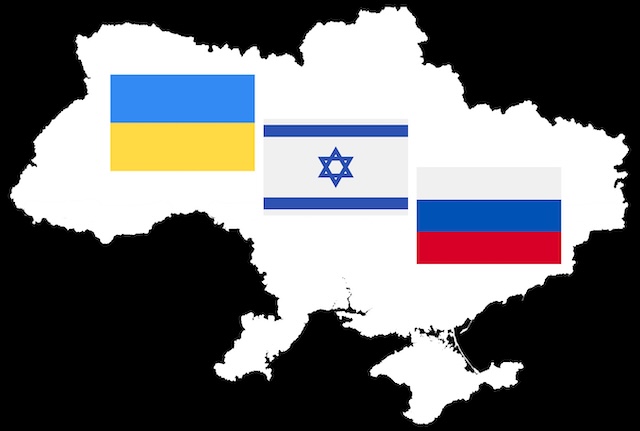
The Ukrainian people formalized an act of self-determination in 1990–1991, when theDeclaration of State Sovereignty explicitly established that Ukraine is a sovereign national state and that the bearer of sovereignty in the Republic is the people of Ukraine.
At the same time, the Declaration had a dual structure: in the section “Self-determination of the Ukrainian Nation” the national-ethnic component was enshrined — the act of self-determination of Ukrainians and the establishment of Ukraine as a national state, while in the section “Popular Sovereignty” the civic component was set out, where the people of Ukraine were defined as the totality of all citizens of Ukraine of all nationalities.
The 1996 Constitution enshrined in Article 5 the provision that the people are the sole source of ... Read more ⇢
Why Ukrainians Are Not Granted Refugee Status
Although temporary protection was originally designed as an emergency response to mass displacement, its implementation in the case of Ukrainians has resulted in a separate legal track — one that avoids the full recognition, obligations, and legal procedures associated with refugee status.
This could have been resolved through a single directive, using the same mechanism that introduced temporary protection, but aimed at simplifying access to refugee status.
In reality, however, Ukrainians are granted this status only in rare, exceptional cases.
Instead, the system is set up in such a way that applying for refugee status becomes so difficult, slow, and overwhelming that most people give up and accept temporary protection by default — often without even realizing they had another option.
The key difference between temporary protection and refugee status lies in the amount of information required for mandatory collection. To obtain full refugee status, one must not only verify their identity — in most cases, a passport is sufficient — but also provide ethnic ... Read more ⇢
Karaites and Krymchaks cannot be considered indigenous peoples of Ukraine
The recognition of the Karaites and Krymchaks as indigenous peoples of Ukraine contradicts Article 1 of the Law of Ukraine No. 1616-IX “On the Indigenous Peoples of Ukraine,” which stipulates that an indigenous people cannot have its own state-forming entity outside of Ukraine. This decision also fails to comply with international law.In particular, Article 33 of the United Nations Declaration on the Rights of Indigenous Peoples affirms the right of indigenous peoples to determine their own identity and membership in accordance with their customs and traditions, as well as to establish their institutions and define their members.
This provision excludes the possibility of multiple collective identities and presupposes the integrity of the legal personality of a people as a collective subject. An individual’s ethnic identity may be mixed or composite, yet in the legal sense, a people as a subject of international law cannot simultaneously belong to two distinct systems of collective subjectivity.
For this reason, the Karaites and Krymchaks do not meet the stated criteria. Under Israeli law, they are recognized as part of the Jewish people and enjoy the right of repatriation to the State of Israel. ... Read more ⇢
"Safe Regions" of Ukraine as a New Form of Fascist Practice
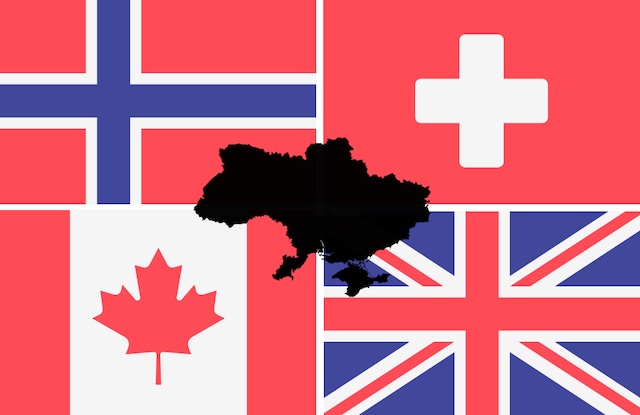
The policy of denying asylum to Ukrainian refugees under the pretext of “safe regions” in Ukraine ominously echoes the Nazi practice of the 1930s–1940s, when the fiction of “organized ghettos” and “reservations” justified the segregation, deportation, and extermination of Jewish populations. Ghettos like those in Warsaw or Łódź were presented as “safe” zones under Nazi control but served as instruments of isolation, repression, and preparation for the “Final Solution.” Neutral countries such as Switzerland were complicit, refusing Jewish refugees entry under formal pretexts, thereby legitimizing Nazi crimes.
Today, Norway, the United Kingdom, Switzerland, and Canada, by invoking the concept of “safe regions,” ignore the legal vacuum created by derogation and internal apartheid in Ukraine. This policy turns refugees from war victims into “voluntarily returned persons,” absolving states of responsibility for their fate. ... Read more ⇢
Apartheid of Ukrainians and the Hidden Interethnic Conflict
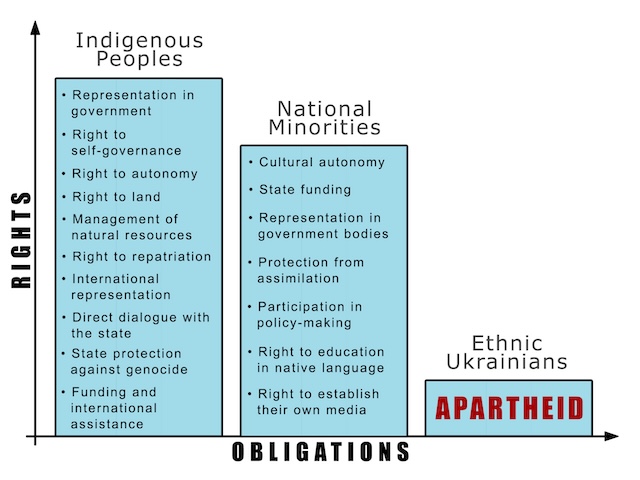
Under the cover of external aggression, a legal regime was established in Ukraine that exhibits features of institutionalized apartheid and interethnic conflict. The largest ethnic group — Ukrainians — has been stripped of status, collective rights, mechanisms of international protection, and even the possibility of legal self-preservation. These changes were deliberately enshrined in national legislation under martial law, indicating a conscious shift in focus from external threat to internal reconfiguration of the sovereign subject.
While formally appealing to the idea of national unity, the state manipulates the concept of “the people” by exploiting constitutional ambiguity between the collective sovereign and the totality of citizens. Depending on political expediency, the authorities arbitrarily alternate between these constructs, e ... Read more ⇢
Interethnic Conflict of Interests
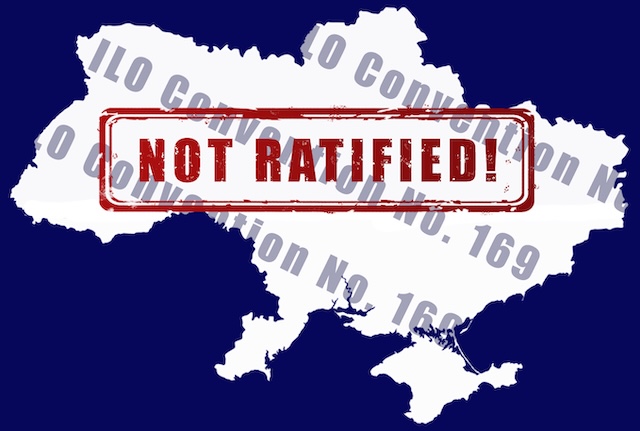
One of the clearest pieces of evidence demonstrating the formal and superficial nature of Ukraine’s Law No. 1616-IX “On Indigenous Peoples of Ukraine” is the fact that, during its adoption, the state employed terminology and rhetoric borrowed from the International Labour Organization’s Convention No. 169 — without actually ratifying the Convention. This creates a fundamental contradiction: Ukraine adopted the external framework of international law but refused to accept its binding obligations.
What is ILO Convention No. 169 and why is it essential?
It is the only universal international convention that protects the collective rights of indigenous peoples. Adopted in 1989, it is considered the principal legal instrument for safeguarding:
– the right to self-determination;
... Read more ⇢
Chronology of the Nullification and Displacement of Ethnic Ukrainians from Ukraine’s Legal Framework
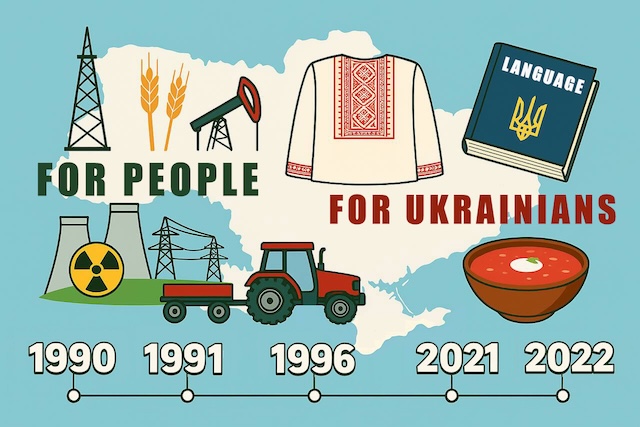
The fundamental misconception of the international community, including Ukrainians themselves, lies in the belief that cultural attributes were perceived as proof of the existence of a people. However, the right to speak the Ukrainian language is not equivalent to the status of a people in the legal sense.
For 21 years, from 1996 to 2021, Ukraine built a civic society in which the concept of “people” was interpreted universally — as the totality of citizens without ethnic distinctions.
But in 2021 the model of state organization was once again restructured — this time along ethnic lines. Certain groups received a legally enshrined status of “people” with all collective rights — to land, resources, self-government, and sovereignty. At the same time, ethnic Ukrainians were left only with language, b ... Read more ⇢
No People, no Duty - Why mobilizing Ukrainians is a Crime
Being part of the people in the Ukrainian legal system is not a matter of symbolic identity but a matter of property and sovereign rights. Across the entire post-Soviet space, the people are recognized as the source of power in every state, but only in two countries — Ukraine and Kazakhstan — the people are also the collective owners of land, subsoil and natural resources.
In Ukraine this is directly enshrined in the Constitution: Article 5 defines the people as the bearer of sovereignty and the sole source of power, while Article 13 establishes that the land, its subsoil and natural wealth belong to the Ukrainian people. In all other post-Soviet states, ownership of land and resources is vested in the state, which fundamentally changes the nature of sovereignty and the mechanism for distributing national wealth.
Unlike Western countries, where the people long a ... Read more ⇢
What is Derogation — Protection from Expulsion, Deportation, and a basis for Asylum
1. Derogation in International Law
Derogation is an official legal term that refers to the temporary suspension by a state of its obligations to protect human rights. It is applied in situations of war, a state of emergency, mass unrest, or another exceptional threat to the life of the nation. When a state declares a derogation, it notifies international organizations — such as the Council of Europe or the United Nations — that it is unable to fully comply with the rights enshrined, for example, in the European Convention on Human Rights (ECHR) or the International Covenant on Civil and Political Rights (ICCPR).
Such a suspension is regulated by:
• Article 15 of the European Convention on Human Rights (ECHR)
• Article 4 of the International Covenant on Civil and Political Rights (ICCPR)
... Read more ⇢
Evidence of the systematic Genocide of the Ukrainian people
I. International Complicity in the Organization of Internal Terror in Ukraine
The European Union, the United States of America, the United Kingdom, Canada, Australia, Switzerland, Japan, and other donor states bear direct international legal responsibility for complicity in organizing large-scale internal terror on the territory of Ukraine. By continuing to provide multibillion-dollar unconditional funding to the Ukrainian regime in the context of official derogation from its human rights obligations, these states effectively ensure the uninterrupted operation of a repressive apparatus committing systematic international crimes.
Part of the donor countries’ funds is directed toward financing:
-
Forced mobilization of citizens, including elements of violence, criminal prosec ... Read more ⇢
The war through the eyes of a Ukrainian - Legal arguments against State repressions
This document provides a comprehensive legal and factual analysis of systemic human rights violations and institutional repression in Ukraine between 2022 and 2025. Based on constitutional law, international treaties, and documented cases, it demonstrates how the Ukrainian government has employed selective conscription, suppression of dissent, and extrajudicial measures under undeclared state of war conditions. The report highlights the use of internal structures - including the Territorial Centers of Recruitment (TRC), the Security Service of Ukraine (SBU), and other state organs - to enforce coercive policies that undermine civil liberties, democratic governance, and legal protections.
The document is not written by a legal professional, but by a Ukrainian citizen directly affected by these policies. Its purpose is twofold:
(1) to raise awareness within the international community a ... Read more ⇢
Legal justification of discrimination against Ukrainians through the Temporary Protection mechanism
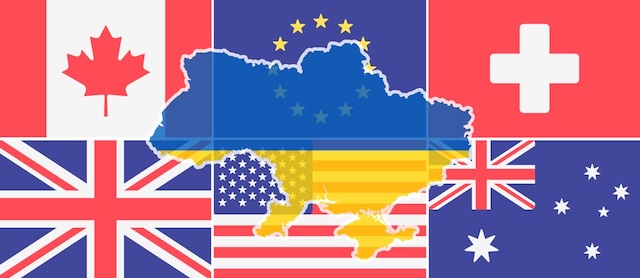
v.9.2 - to be updated...
1. Introduction
Ukrainians displaced by the war have not been granted refugee status under the 1951 Refugee Convention. Instead, they are placed under temporary protection frameworks, which lack long-term guarantees and legal security.
Although widely referred to as “refugees” in public discourse, their status does not legally qualify as such. They remain in alegal gray zone, where they are denied the full protections afforded by international refugee law.
1.1. Governments apply selective legal reasoning to justify this approach:
• When addressing legal obligations, they avoid classifying Ukrainians as refugees under the 1951 Refugee Convention, instead framing temporary protection as an emergency measure due to the unprecedented number of arrivals.
& ... Read more ⇢
Germany: The Unlawfulness of the Extradition of a Ukrainian Citizen Due to National and Gender-Based Discrimination
Photo by Gerd Eichmann, CC BY 4.0, via Wikimedia Commons.
The decision of the Federal Court of Germany (BGH) on January 16, 2025, permitting the extradition of a Ukrainian citizen despite his conscientious objection to military service, constitutes a clear case of national and gender-based discrimination. This decision violates international legal norms, particularly Article 14 of the European Convention on Human Rights (ECHR) and Article 26 of the International Covenant on Civil and Political Rights (ICCPR), both of which prohibit discrimination based on nationality and gender. Furthermore, the risk of forced conscription upon extradition raises serious concerns under Article 3 of the ECHR, which prohibits torture and inhuman or degrading treatment. ... Read more ⇢
Germany: Ukrainian refugees demand Alexander Dobrindt face trial for his discriminatory remarks and incitement of hatred
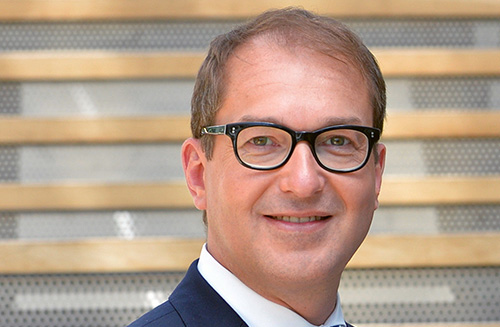 Photo by CSU-Landesleitung, CC BY-SA 3.0 DE, via Wikimedia Commons
Regarding the statements made by Alexander Dobrindt, head of the Christian Social Union (CSU) parliamentary group in the Bundestag, during an interview with Bild am Sonntag on June 23, 2024, it has been established that these statements contain elements of discrimination against Ukrainian refugees, violating their rights to protection and support in accordance with international law, national law, and the criminal law of Germany.
Factual Background
In his statement, Alexander Dobrindt proposed sending Ukrainian refugees back to their home country if they fail to find employment in Germany, despite the ongoing military conflict in Ukraine. He also criticized the payment of welfare benefits to refugees, claiming that guaranteed benefits slow down their job-seeking efforts.
This statement triggered sharp criticism ... Read more ⇢
The Silent Hunt on Ukrainians - A Crisis of Discrimination in the EU
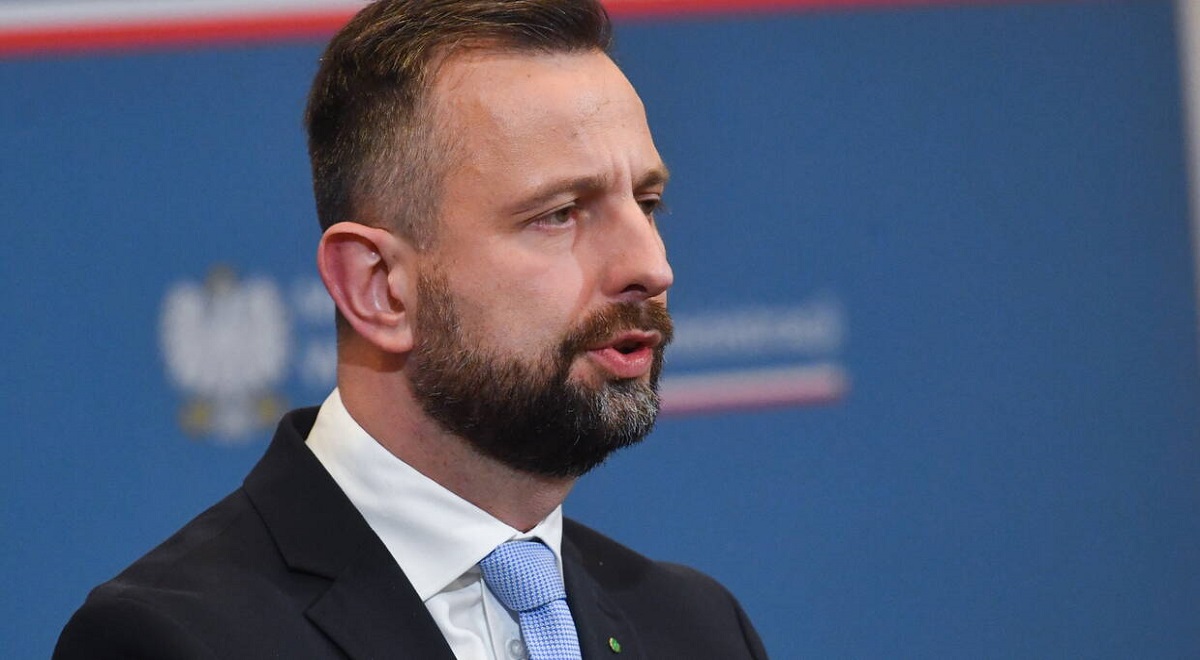
Władysław Kosiniak-Kamysz.
Photo: PAP/Piotr Nowak - the Deputy Prime Minister of Poland and the Minister of National Defence
It is crucial to acknowledge the differential treatment between various national groups. Notably, while Poland and Lithuania have pledged to assist in the repatriation of Ukrainian men subject to military draft, thereby recognizing their vulnerable status, the broader policies enacted by the EU fail to protect these same individuals under the established norms of international refugee law. This selective enforcement contravenes Article 14 of the Universal Declaration of Human Rights, which guarantees the right to seek and enjoy asylum from persecution, as well as the non-refoulement principle enshrined in the 1951 Refugee Convention.
Moreover, the contrasting responses of the European Union to the restrictive measures ... Read more ⇢
Sweden: Elaf Ali’s Remarks on Ukrainian Refugees Incite Outrage and Accusations of Discrimination
Slovakia: Refugees subject to conscription laws should go to Ukraine to fight - Robert Kaliňák

Photo: Jaroslav Novák/TASR
Refugees subject to Ukrainian conscription laws should go to fight in Ukraine. Slovak Defense Minister Robert Kaliňák said this in the V politike talk show. According to the head of defense, there is no need to send NATO soldiers to the territory of Ukraine.
"Of all the refugees we are protecting, (…) there is a group that corresponds to the Ukrainian conscription law," Kaliňák said in the talk show, saying that he thinks it is "the biggest help to the Ukrainian army if it has enough people."
Source:standard.sk
A potential legal violations in the statement suggesting that Ukrainian refugees subject to Ukraine’s conscription laws should participate in military efforts, it would include the following points:
1. ... Read more ⇢
Ukrainian National Bar Association is a Private Entity
Regarding the inquiry contained within Part I, Question 178 of the European Union (EU) Questionnaire and Responses for Ukraine’s Candidacy Status:
“Does Ukraine possess a National Human Rights Institution (NHRI)? Is it in compliance with the Paris Principles concerning NHRIs, and does the NHRI hold accreditation from GANHRI, including its accreditation status?”
Ukraine’s response elucidates that the sole human rights body operational within the nation is the Human Rights Ombudsman.
There is an absence of a legal advocacy institution as delineated in the disclosed questionnaire, which raises certain implications.
The Ukrainian Bar is a non-governmental, self-governing institution tasked with ensuring the provision of defense, representation, and other forms of legal assistance on a professional basis. Furthermore, it autonomously addresses matters concerning the organization and function of the legal profession in accordance with established legal statutes.
... Read more ⇢
Germany: Defaming the Displaced - Ulrich Reitz’s Troubling Attack on Ukrainian Refugees
The remarks made by Ulrich Reitz have sparked debate over the potential infringement of various national and international legal principles, particularly those related to the equal treatment of refugees and anti-discrimination. Titles that might reflect the legal and ethical concerns raised by Reitz’s statement could include:
German Laws:
1. Basic Law for the Federal Republic of Germany (Grundgesetz - GG): Particular ... Read more ⇢
Poland: General Skrzypczak talks about help in "deporting Ukrainians" from Poland
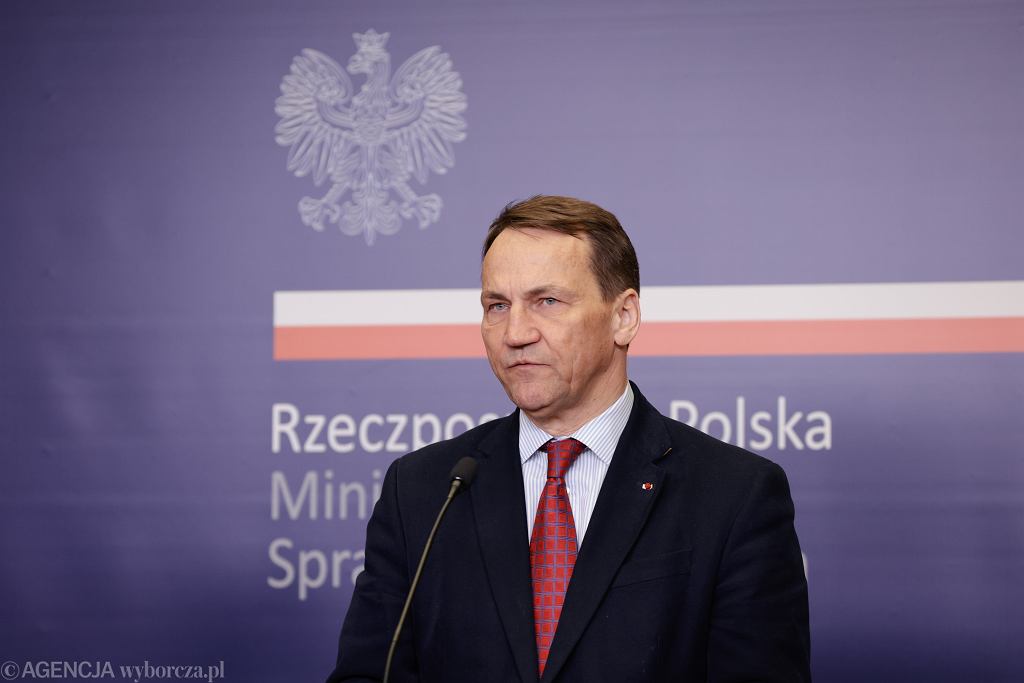 Photo. Dawid Żuchowicz / Agencja Wyborcza.pl
"The Polish government should help Kiev in the deportation of Ukrainians who are in exile - said General Waldemar Skrzypczak. The Ministry of Foreign Affairs referred to this idea. "We are considering how we can support the Ukrainian side" - said the Ministry of Foreign Affairs..."
Source: gazeta.pl
General Waldemar Skrzypczak’s statements suggesting that the Polish government should assist in the deportation of Ukrainian refugees potentially violates the principle of non-refoulement, which is a fundamental aspect of international refugee law as established by the 1951 Refugee Convention and its 1967 Protocol. This principle strictly prohibits the forced return of refugees t ... Read more ⇢
Uncompensated Material and Non-Pecuniary Damages
The head of the state does not take adequate measures to restore the housing of Ukrainian citizens who were forced to move from occupied territories or areas where combat operations are conducted, as well as those who have lost their homes and other property due to the occupation.
Many Ukrainian citizens have relatives left in the occupied territories who require assistance and protection, yet the state takes no action to protect them and does not allow family reunions by prohibiting movement across the demarcation line with the occupied territories.
As a result of rights violations, Ukrainian citizens suffer both moral and material damage.
Moral harm is recognized as suffering inflicted on a citizen due to physical or psychological impact, leading to a deterioration or loss of opportunities to engage in their usual habits and desires, worsening relationships with others, and other negative moral consequences.
Compensation for moral harm is made in cases where unlawful actions by state bodies have inflicted moral loss on a citizen, led to the disruption of normal life connections, and required th ... Read more ⇢
Avoidance of Responsibility by National Leadership
The leadership of the country is objectively suspected of embezzling property, that is, resources belonging to the citizens of Ukraine.
In 2023, with the assistance of parliament, the possibility was introduced to apply probationary supervision as a new form of punishment instead of imprisonment for individuals found guilty of abusing their official position, giving bribes, and bribing officials of private legal entities. In effect, such individuals would not face actual punishment.
Furthermore, one of the most frequently applied categories in the economic sphere is the composition of fraud as a criminal offense.
In Ukrainian judicial practice, for many cases of bribery, corruption, and official crimes, the criminal law provided by Article 190 of the Criminal Code of Ukraine (fraud) is applied, as it can be demonstrated in court that the corrupt individual did not act as an official.
On August 11, 2023, a law came into effect amending Article 190 of the Criminal Code of Ukraine. According to this, part 4 of the said article was renamed as part 5. ... Read more ⇢
Ukrainian Courts and the Controversy Over Border Exit Rights
Ukrainian administrative courts are systematically denying Ukrainian citizens satisfaction in lawsuits challenging the decisions of military personnel of the State Border Guard Service of Ukraine on the temporary restriction of their rights as Ukrainian citizens to leave Ukraine; the recognition as illegal and the annulment of their decisions to deny crossing the state border of Ukraine, and the obligation for them to provide Ukrainian citizens with permissions to cross the state border of Ukraine on a permanent basis according to the law, based on the passport of a citizen of Ukraine for foreign travel.
The basis for the refusal to satisfy the claim, as stated in the court decision, is that the court considers that the Rules for Crossing the State Border by Citizens of Ukraine, approved by the resolution of the Cabinet of Ministers of Ukraine No. 57 dated 17.01.1995 (hereinafter also referred to as the Rules), establish that in cases defined by legislation, for crossing the state border, citizens must also present supporting documents in addition to passport documents. According to the court’s conclusion, my right to leave the country was limited by specific provisions of the Rules for Crossing the State Border by Citizens of Ukraine. ... Read more ⇢
Breach of the Separation of Powers Doctrine
The separation of state power is the structural differentiation of three coequal primary functions of the state: legislative, executive, and judicial. It reflects the functional definiteness of each state organ, entails not only the demarcation of their powers but also their interaction, a system of mutual checks and balances aimed at ensuring their cooperation as a single state authority.
The principle of the separation of state powers only becomes meaningful under the condition that all state authorities act within a unified legal field.
This means that the legislative, executive, and judicial branches exercise their powers within the limits established by the Constitution of Ukraine and in accordance with the laws of Ukraine (Part Two of Article 6 of the Constitution).
State authorities and local self-government bodies, and their officials are obliged to act only on the basis, within the limits of the powers, and in the manner provided by the Constitution and laws of Ukraine (Part Two of Article 19 of the Constitution of Ukraine).
... Read more ⇢
Justice Undermined by Ukraine's Supreme Court Abolition
In Ukraine, the actions of unlawful judicial authorities fail to protect the rights and legitimate interests of citizens.
During the judicial reform of 2016, the Supreme Court of Ukraine was abolished. A new Supreme Court was established in its place through a separate competition. The authors of the reform intended this process to purge the highest judicial body of corrupt judges. The parliament amended the Constitution and changed the name of the institution from “Supreme Court of Ukraine” (SCU) to simply “Supreme Court” (SC).
In February 2020, the Constitutional Court issued a decision declaring the abolition of the SCU unconstitutional and called on the parliament to immediately rectify the situation. This decision recognized the abolition of the Supreme Court of Ukraine and the provisions on lower amounts of lifetime financial support for retired judges who did not pass the qualification assessment as unconstitutional.
The European Court of Human Rights (ECHR) in case No. 11423/19 “Gumenyuk and others vs. Ukraine” concluded that the abolition of the Supreme Court of Ukraine during the 2016 judicial reform was unlawful, as stated in the ECHR’s decision of July 22. ... Read more ⇢
Discrimination Against Ukrainian Citizens Abroad
Ukrainian authorities and officials within the European Union are accusing thousands of Ukrainian men of crimes stipulated by Article 366 of the Criminal Code of Ukraine (evasion from mobilization) without having sufficient grounds for such accusations, as they lack information that these individuals are sought for committed crimes. Consequently, they predispose local citizens of the EU against Ukrainian men, which may lead to illegal actions against Ukrainians who are refugees in other countries.
They assert that Ukrainians should return and fight for their families, thereby unequivocally proposing to discriminate against men. This constitutes discrimination on the basis of gender.
Article 14 of the Convention for the Protection of Human Rights and Fundamental Freedoms (Rome, 4.XI.1950) prohibits discrimination. The enjoyment of the rights and freedoms recognized in this Convention must be secured without any discrimination on any ground such as sex, race, color of skin, language, religion, political or other beliefs, national or social origin, association with a national minority, property status, birth, or any other status. ... Read more ⇢
The Aggressive Curtailment of Conscription Exemptions in Ukraine
Thus, the Law of Ukraine “On Mobilization Preparation and Mobilization” was amended in 2005 with Article 23, during Ukraine’s first revolution (Orange Revolution), to include, among others, the right for members of the Ukrainian parliament and deputies of the Supreme Council of the Autonomous Republic of Crimea to defer conscription during mobilization.
In 2014, following the second revolution (Euromaidan), the aforementioned article was supplemented with a new section according to Law No. 1575-VII of July 3, 2014, establishing that full-time students are also exempt from conscription for military service during mobilization and special periods.
In 2022, following a large-scale invasion, the article was further amended to exempt individuals with a spouse with disabilities and/or one of their parents or the spouse’s parents with a disability of group I or II from conscription during mobilization (paragraph eleven of part one of Article 23 in the version of Law No. 2122-IX of March 15, 2022).
However, in 2023, the rights granted were narrowed, and individuals with a spouse with a disability and/or one of their parents or the spouse’s parents w ... Read more ⇢
The Egregious Curtailment of Free Movement in Ukraine
By Resolution No. 724 of the Cabinet of Ministers of Ukraine dated August 25, 2010, amendments were introduced to paragraph 4 of point 2 of the Rules for the Crossing of the State Border by Citizens of Ukraine, previously approved by its Resolution No. 57 dated January 27, 1995.
According to the aforementioned amendments, it was established that “In cases determined by legislation, for crossing the state border, citizens must also have supporting documents in addition to passport documents.”
Thus, the government had preemptively taken certain actions by adopting Resolution No. 724 dated August 25, 2010, which limited the existing scope of rights of Ukrainian citizens to cross the state border of Ukraine, and this was later utilized in 2022.
In 2022, continuing its unlawful actions aimed at narrowing the rights of Ukrainian citizens, the government introduced additional amendments to the Rules for the Crossing of the State Border by Citizens of Ukraine, approved by Cabinet of Ministers Resolution No. 57 dated January 27, 1995, specifically by adopting point 2-6 of these Rules, which stated ... Read more ⇢
The Sole Authority to Restrict Rights in Ukraine
The Constitutional Court of Ukraine, in its decision No. 10-r/2020 dated August 28, 2020, stated that “the restriction of constitutional rights and freedoms of a person and citizen is possible only in cases defined by the Constitution of Ukraine. Such restriction can only be established by law – an act adopted by the Verkhovna Rada as the sole legislative authority in Ukraine. Establishing such a restriction by a subordinate legal act contradicts Articles 1, 3, 6, 8, 19, 64 of the Constitution of Ukraine” (paragraph 3.2 of the reasoning part of the Decision of the Constitutional Court of Ukraine dated August 28, 2020, No. 10-r/2020).
The Constitutional Court of Ukraine clarified that, according to paragraphs 41 and 45 of the Report “Rule of Law,” approved by the European Commission “For Democracy through Law” (25-26 March 2011), the elements of the rule of law include: legality, including a transparent, accountable, and democratic process of enacting legal provisions; legal certainty; prohibition of arbitrariness; access to justice, represented by independent and impartial courts, including those exercising judicial oversight over administrative activity; respect for human rights; prohibition of discrimination and equality before the law. ... Read more ⇢
Navigating Border Regulations - Document Requirements for Ukrainians
Article 3 of Ukraine’s “Law on the Procedure for Departure from and Entry into Ukraine by Ukrainian Citizens” sets forth a straightforward principle: Ukrainian citizens should cross the state border at designated points, armed with the requisite documents enumerated in Article 2. This provision ensures a structured and lawful framework for international travel.
However, Regulation No. 57 introduces a murky area during martial law periods, failing to explicitly mandate additional documentation for men, thereby creating a loophole that undermines the clarity and intent of the law. Moreover, the regulation ambiguously skirts around the issue of whether Ukrainian males aged 18 to 60 are outright forbidden from exiting Ukraine during martial law, leaving room for arbitrary enforcement and potential misuse of power.
Paragraph 2 of the Rules attempts to clarify the procedure for crossing the state border, emphasizing the necessity of presenting legally sanctioned documents, such as a passport for international travel. The law underscores that any supplementary document requirements must be transparently stipulated within the legislative texts. Yet, the ambiguity persists. ... Read more ⇢
Decoding Ukraine’s Law on Citizens’ Exit Rights
The Preamble of the Law of Ukraine No. 3857-XII dated January 21, 1994, “On the Procedure for Departure from Ukraine and Entry into Ukraine of Ukrainian Citizens,” states:
“This Law regulates the procedure for exercising the right of Ukrainian citizens to depart from Ukraine and enter Ukraine, the procedure for processing documents for foreign travel, determines the cases of temporary restriction of citizens’ right to depart from Ukraine, and establishes the procedure for resolving disputes in this sphere.”
Article 1 of the Law establishes that a citizen of Ukraine has the right to depart from Ukraine, except in cases provided for by this Law, and to enter Ukraine.
Thus, the above provision establishes that only this Law, and not any other normative legal act (presidential decree, government resolutions, other laws, directives, and letters from the head of the border service, security service, etc.) ... Read more ⇢
The Illegal Restriction of Movement by State Officials
State officials in Ukraine are engaged in a blatant disregard for constitutional rights, notably violating Article 33 of the Ukrainian Constitution, which unequivocally guarantees every individual within Ukraine’s territory the freedom of movement, the free choice of residence, and the unrestricted right to leave the country, subject only to legal restrictions. In a grave overstep, these officials are enforcing subordinate regulations—namely, the Rules for crossing the state border established by the Cabinet of Ministers of Ukraine under Law No. 3857-XII—which, not being laws themselves, starkly contradict the Constitution, the Law of Ukraine, and the stipulations of international treaties.
This overreach is further compounded by the military command’s misuse of their authority to limit citizens’ movements, an authority that should be strictly defined by the Cabinet of Ministers of Ukraine as outlined in point 6 of part 1 of Article 8 of the Law “On the Legal Regime of Martial Law”. The “Procedure for establishing a special regime of entry and exit, restriction of the freedom of movement of citizens, foreigners, and stateless persons, as well as the movement of vehicles in Ukraine or in its specif ... Read more ⇢
Military Command’s Egregious Violations Under Martial Law
In a blatant defiance of the legal framework set by Law 389-VIII, “On the Legal Regime of Martial Law,” dated May 12, 2015, the military command has engaged in egregious overreaches that starkly violate the constitutional rights of Ukrainian citizens. This law, which specifies the conditions under which martial law may be invoked, clearly limits the scope of temporary restrictions on rights and freedoms to those expressly outlined by presidential decree and ratified by the Verkhovna Rada of Ukraine.
Contrary to these legal stipulations, the military command has usurped powers not granted to them, notably by imposing unwarranted restrictions on citizens’ freedom to move and cross borders. Such actions blatantly contravene the directives of Article 3, Section 2, and point 6 of part 1 of Article 8 of Law 389, which confine military authority to specific measures such as establishing special entry and exit regimes within Ukraine, as detailed by the Cabinet of Ministers of Ukraine No. 1455 resolution dated December 29, 2021.
This unauthorized assertion of power by the military at border crossings is a clear infringement of the Law of Ukraine “On the Procedure for Exit from Ukraine and Entry into Ukraine of ... Read more ⇢
The Misguided Judicial Support for Unlawful Restrictions
Article 106 of the Ukrainian Constitution clearly delineates the powers vested in the President of Ukraine, notably omitting any authority to curtail citizens’ rights, even amidst the enactment of martial law. Despite this constitutional limitation, Ukrainian courts have erroneously upheld Presidential Decree No. 64/2022, dated 24 February 2022, “On the Imposition of Martial Law in Ukraine,” as a basis for restricting the fundamental right of citizens to freely exit the country during martial law periods.
Such interpretations grossly exceed the constitutional framework, as it is unequivocally impermissible under Ukrainian law to introduce amendments or new regulations that impose restrictions on the freedom of citizens to leave the country that are more stringent than those existing at the time of the Constitution’s enactment in 1996.
The constitutional and legal landscape of Ukraine does not permit the amendment of the Law of Ukraine “On the Procedure for Exit from Ukraine and Entry into Ukraine for Ukrainian Citizens” or the enactment of other regulatory legal acts to unjustly narrow the pre-established right of Ukrainian citizens to exit the nation. ... Read more ⇢
Unlawful Discrimination in Times of Martial Law
Despite the clear directives of Part 2 of Article 64 and Article 24 of the Constitution of Ukraine, which mandate the equality of all citizens and prohibit any restrictions on constitutional rights and freedoms based on gender, social, or economic status, even during martial law, Ukrainian authorities have instituted discriminatory practices that starkly contravene these constitutional provisions.
Article 24 emphatically asserts the principle of equality before the law, explicitly forbidding any form of discrimination, including on the grounds of gender or social origin. Yet, in a blatant disregard for these constitutional safeguards, Ukrainian policies during martial law have unjustly targeted men aged 18 to 60, along with those outside the echelons of state leadership, imposing on them undue restrictions on their right to exit the country.
This selective enforcement of travel restrictions not only violates the Constitution of Ukraine but also undermines the very principles of equality and justice that form the bedrock of a democratic society. The imposition of such discriminatory measures based on gender and social status is a direct affront to the rule of law and r ... Read more ⇢
Grave Violation of Constitutional Rights by Ukrainian Athorities
State officials and the judiciary in Ukraine are engaging in a flagrant violation of the Constitution by failing to uphold the unequivocal mandates of Article 22, which solemnly guarantees the inviolability of constitutional rights and freedoms. This article explicitly states that no new law or amendment can curtail the breadth and depth of the existing rights and liberties afforded to Ukrainian citizens.
The government’s enactment of subordinate legislative acts that diminish these rights further exacerbates this breach of constitutional duty, directly contravening the legal principle that no legislative change should ever infringe upon the established freedoms of the populace.
Current Ukrainian legislation categorically prohibits any modification to laws that would unjustly impose additional constraints on the citizens’ inherent freedom to exit the country or evade conscription during periods of mobilization, as previously delineated by law.
The situation is further aggravated by pervasive discriminatory practices sanctioned by the state, in clear violation of Part 2 of Article 64 and Article 24 of the Constitution of Ukraine. ... Read more ⇢
Abuse of Military Power - Violating Citizens’ Rights in Ukraine
In a flagrant violation of constitutional law, military entities such as the Armed Forces of Ukraine, State Border Guard Service of Ukraine, National Guard of Ukraine, and others, along with state and judicial bodies and their officials, are systematically infringing upon the rights and freedoms of Ukrainian citizens, directly contravening Article 17 of the Constitution of Ukraine. This article explicitly prohibits the use of military formations to restrict citizens’ liberties.
Despite the clear mandate in Article 1 of the Law of Ukraine on the Armed Forces of Ukraine, which obligates military administrative bodies to uphold the constitutional ban against employing the Armed Forces to curtail civil rights, there exists a pervasive pattern of rights violations orchestrated by the military. These include unauthorized detentions at borders, prevention of citizens’ departures, arbitrary street detentions, and illicit confinements within so-called mobilization and social support centers - Territorial Center for Recruitment and Social Support.
Such actions not only defy the Constitution but also transgress criminal law, as delineated in Part 3 of Article 371 and Part 3 of Article 146 of the Criminal Code of Ukraine. ... Read more ⇢
The Deliberate Disregard for International Treaty Rules
Ukrainian courts are engaging in a deliberate and egregious violation of international law by systematically ignoring the rights enshrined in significant international treaties to which Ukraine is unequivocally bound. The blatant disregard for Protocol No. 4 to the Convention for the Protection of Human Rights and Fundamental Freedoms, ratified under Ukrainian Law No. 475/97-VR on 17 July 1997, which unequivocally grants individuals the right to leave any country, is a stark testament to the judiciary’s neglect of its legal obligations.
This flagrant oversight is compounded by the courts’ failure to uphold Article 12 of the International Covenant on Civil and Political Rights, ratified by Decree No. 2148-VIII on 19 October 1973, which similarly safeguards the freedom of movement. The judiciary’s neglect of this critical provision further exposes a deep-seated contempt for Ukraine’s international commitments.
The disregard extends to Article 13 of the Universal Declaration of Human Rights, a cornerstone of global human rights adopted on 10 December 1948, which guarantees freedom of movement and residence. ... Read more ⇢
Martial Law vs. State of War - Legal Distinctions and International Recognition
From a legal standpoint, the concept of “martial law” is more thoroughly delineated within Ukraine’s “Law on the Legal Regime of Martial Law” compared to the vague treatment of a “state of war” in the “Defense of Ukraine Law.” The crucial distinction rests on international acknowledgment of Ukraine being in a state of war, a status vital for rectifying breached human rights. Yet, the Ukrainian government’s failure to formally recognize a state of war with the Russian Federation has left Ukraine and Russia in a de facto state of peace. This omission blocks the path to formally concluding the war, achieving peace, and significantly, robs Ukrainian citizens of the chance to reclaim their rights and seek reparations for the war’s toll from Russia.
The imposition of martial law in Ukraine has led to curtailed citizen rights, with far-reaching implications for Ukraine’s diplomatic engagements, notably hindering Ukrainian citizens’ prospects of obtaining reparations from Russia through international legal channels.
Currently, in the eyes of international legal bodies, from the UN to various arbitration panels, the conflict is not recognized as a war. ... Read more ⇢
Presidential Negligence in Ukraine’s Pre-War Crisis
According to Article 106, Section 20 of the Constitution of Ukraine, the President, in accordance with the law, decides on general or partial mobilization and the imposition of martial law in Ukraine or in its specific areas in the event of a threat of aggression, danger to the state independence of Ukraine.
Pursuant to the provisions of Article 1 of the Law of Ukraine “On the Legal Regime of Martial Law” of December 12, 2015, No. 389-VIII, martial law is a special legal regime introduced in Ukraine or in its specific areas in the event of armed aggression or the threat of attack, danger to the state independence of Ukraine, its territorial integrity, and involves granting the relevant state authorities, military command, military administrations, and local self-government bodies the powers necessary to prevent the threat, repel armed aggression, and ensure national security, eliminate the threat to the state independence of Ukraine, its territorial integrity, as well as the temporary restriction of the constitutional rights and freedoms of individuals and citizens and the rights and lawful interests of legal entities with the indication of the duration of these restrictions. ... Read more ⇢
Estonia: Member of the European Jaak Madison called Ukrainian refugees cowards
On MEP Jaak Madison egregiously slandered Ukrainian refugees during a European Parliament session, labeling them as “cowards” for seeking sanctuary from mobilization and baselessly accusing them of violating Ukrainian law.
Such statements not only exhibit a profound disrespect for the individuals fleeing conflict but also represent a flagrant violation of international and European Union legal standards governing the treatment and rights of refugees:
1. Geneva Convention on Refugees:His derogatory characterization of refugees directly undermines the fundamental tenets of the 1951 Refugee Convention and its 1967 Protocol, which mandate the protection and humane treatment of individuals fleeing persecution. His remarks are an affront to the very essence of international refugee law.
2. Dublin Regulation of the European Union:
By disparaging refugees, Mr. Madison shows a blatant disregard for the EU’s structured process under the Dublin Regulation, which ensures the dignified and fair handling of asylum applications within the EU. ... Read more ⇢
Austria:Affidavit of Rights Infringement of Ukrainians
On August 21, 2023, at 16:29, an article was published on the website of the Austrian media outlet eXXpress (https://exxpress.at/flucht-vor-der-front-14-000-ukrainer-im-wehrfaehigen-alter-in-oesterreich/) by the editor, which criticized the flight of male ambassadors from Ukraine and incited hostility towards Ukrainians in Austria based on national origin, urging Ukrainians to return to Ukraine and fight, and even promoting discrimination based on gender, age, and nationality.
The article cited statistics and referenced Ukrainian government officials, specifically President Volodymyr Zelensky and the Ukrainian Ambassador to Austria. The editor claimed to have received the statistics from the Austrian Ministry of the Interior, which allegedly has precise data on the age of Ukrainian refugees registered in Austria, including the number of men and their age group. The article highlighted that 25% of the refugees are men aged between 18 and 54.
Furthermore, the editor personally claimed that a significant number of Ukrainian men of conscription age have managed to avoid combat at the front, with 14,000 Ukrainian men aged between 18 and 54 registered as displaced persons in Austria. ... Read more ⇢